



Quackers: Four Ducks Reshape the Grid Before Wins Are Counted
A rundown of ELK Studios’ new release Quackers. The key points are the four-duck features on a 6×6 cluster grid, a coin game triggered by 20 coins, and an 8×8 bonus. RTP up to 96%, max win 10,000x, hit frequency 29.7%.

Key takeaways
- On August 5, ELK Studios released Quackers, a 6×6 cluster game.
- The four ducks use multiplier, symbol value, and wild upgrade features before wins are calculated.
- Collecting 20 coins opens the coin game.
- In the bonus, the grid widens to 8×8 and the ducks stay until the end. RTP up to 96%, max win 10,000x.
ELK Studios released Quackers on August 5. It is a cluster game on a 6-reel, 6-row grid where touching matching symbols win. It does not use paylines or ways; a win occurs when the same symbols form a group touching horizontally or vertically. The stars are four ducks gathered at a pond.
The official description reads: “A pond where the lotus is calm but the ducks are completely out of their minds.” A heroine in the moonlight, a screen diva, a fearless aviator, and an explosion-loving troublemaker have gathered for a legendary pond party.
From the product sheet illustrations, you can quickly tell the four ducks apart. A duck with a headband holding a cane, a blonde duck with a pearl necklace, a duck with a bandage holding dynamite, and an aviator duck wearing goggles. The stage is a pond with a pink flamingo float and lotus flowers. The launch video is also short, ending on a single scene of the logo rising from the water among lotus leaves.
Four ducks, four features
The ducks are at the heart of Quackers. All four have their own feature, and each one triggers before wins are calculated. The board changes first, and then the wins are decided.
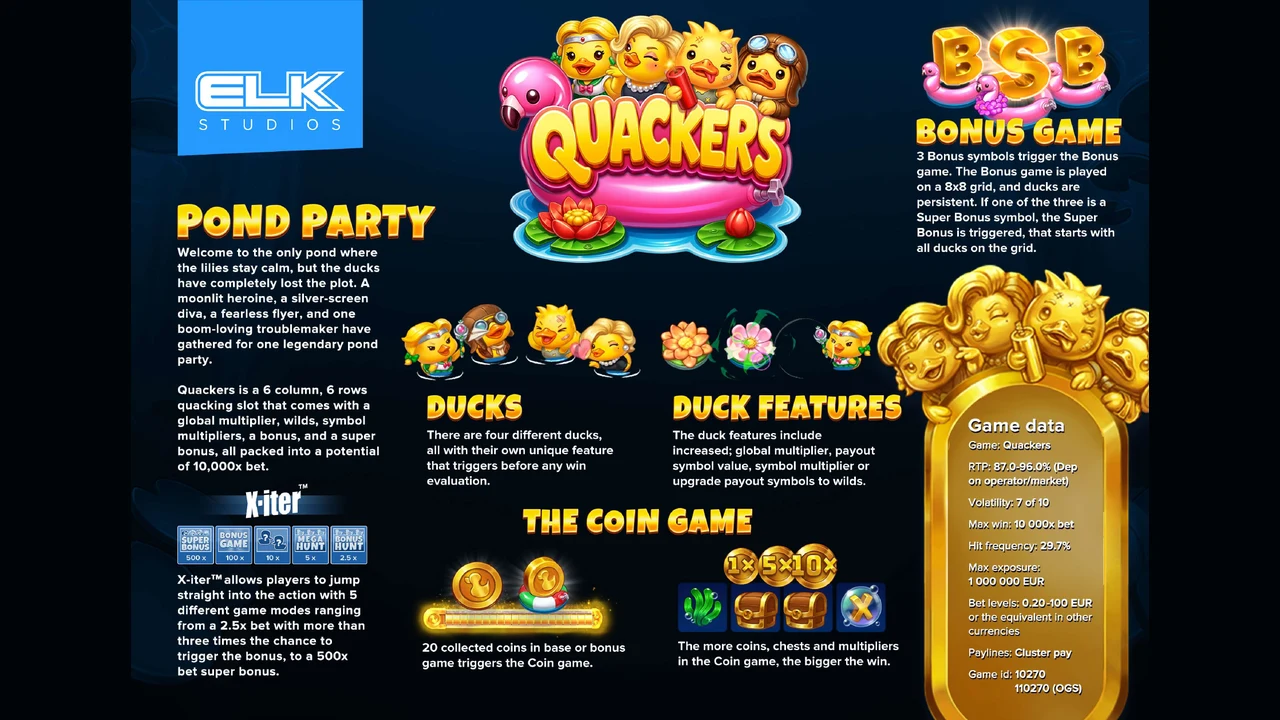
ELK says the duck features come in four kinds. They raise the grid-wide global multiplier, raise the value of pay symbols, raise individual symbol multipliers, or upgrade pay symbols to wilds. The product sheet does not say which duck handles which feature.
What matters is that the features come before the win is calculated. Even a grid that did not look like a win can connect a cluster if one duck turns a symbol into a wild. Conversely, a spin where no duck moves ends as an ordinary one.
The four features grow stronger when they overlap. When an individual symbol multiplier is attached to a grid where pay symbol values have risen, and a global multiplier is stacked on top of that, the payout for the same cluster can jump several times over. The more ducks appear in a spin, the more reason you have to watch the result through to the end.
Coin game when 20 coins are collected
The second pillar is the coin game. It opens when you collect 20 coins, whether in the base game or the bonus game. A bar at the bottom of the screen shows your collection progress.
Inside the coin game, coins, chests, and multipliers drop. The product sheet also includes illustrations of 1x, 5x, and 10x multipliers. The more coins, chests, and multipliers appear, the bigger the win. Coins keep accumulating during the bonus too, so the bonus and the coin game can flow into each other.
The coin game screen shows cells with seaweed and an X mark in addition to coins and chests. The intro doesn’t explain what role each cell plays. Opening the demo yourself is the fastest way to find out.
The bonus expands to 8×8
When 3 bonus symbols appear, the bonus game starts. The grid expands to 8×8, and during the bonus the ducks stay on the grid. In the base game the ducks come and go, but in the bonus, once a duck enters, it works until the end.
If one of the three is a super bonus symbol, it becomes a super bonus. The difference is that all four ducks are already on the grid from the start. All four features run together from the first spin, so this is where the game’s flashiest moments come from.
There are five X-iter™ modes you can buy directly. It is ELK’s bonus buy system, with a lower entry point and a higher cap than Pirots 5.
| X-iter mode | Price |
|---|---|
| Bonus hunt | 2.5x bet (bonus chance 3x or more) |
| Mega Hunt | 5x bet |
| Question mark icon mode | 10x bet |
| Bonus game | 100x bet |
| Super bonus | 500x bet |
Cluster board grows from 36 to 64 cells
A 6×6 grid has 36 cells and an 8×8 grid has 64 cells. Entering the bonus increases the number of cells by nearly 1.8 times. In a cluster game, more cells means more places for matching symbols to touch. The bigger the clusters get, the bigger the payouts.
On top of this, the four ducks stay throughout the bonus. In the base game the ducks appear and disappear, but in the bonus, once a duck enters, it uses its feature on every spin before wins are calculated. The widened grid and the ducks that stay are what give the bonus its weight.
Around the same time, ELK cut the super bonus price to 250x in Pirots 5. Quackers, by contrast, kept it at 500x. The super bonus in Quackers starts with all four ducks already on the grid.
The numbers
RTP is 87.0-96.0% depending on the operator and market, and volatility is 7 out of 10. Max win is 10,000x the bet, and the maximum payout limit is 1 million euros. Bets range from 0.20 to 100 euros. At the top bet of 100 euros, multiplying by 10,000 gives exactly 1 million euros, so the payout limit and the max win line up perfectly.
The number worth noting is the hit frequency of 29.7%. ELK’s new release from around the same time, Pirots 5, was at 25.1%, so wins land a bit more often here.
In short
Quackers is a game where the characters hold the features. Four ducks change the board before wins are tallied, and 20 coins open a separate coin game. In the bonus, the board expands to 8×8 and the ducks stay put. The Super Bonus is 500x the X-iter, the most expensive among this batch of new ELK releases. Try the free demo and you’ll quickly tell which duck uses which feature.
Source: ELK Studios official news · ELK Studios product brochure · ELK Studios official launch video