


The Truth About RTP Versions: Why the Same Slot Can Be 96% or 88%
There are slots with identical graphics and rules but a different long-term payout rate. Using official materials, we trace how RTP versions arose back in the offline slot machine era, how taxes and regulation expanded them, how each provider discloses them, and how to check the version on your own screen.

Key takeaways
- RTP versions are a structure where only the probability settings of the same game are changed and certified in several copies, and the operator picks one.
- The background to the online spread is tax and regulation. The MGA lowered the online minimum RTP from 92% to 85% in May 2021, and Germany has taxed the amount bet since July 2021.
- Hacksaw Gaming publishes the RTP of Wanted Dead Or a Wild in four versions, from 96.38% down to 88.42%, which is about a 3.2x difference in house edge.
- The actual version must be confirmed from the RTP shown on the in-game rules or help screen, not from the provider’s official page.
With RTP versions (Variable RTP), a provider builds and certifies several copies of one slot with identical graphics and rules but different return rates, and the operator that actually runs the game picks one of them. Even for a game with the same name, the long-term return rate can be 96% or 88% depending on where you play it.
This is an in-depth guide that traces why RTP versions exist, starting from the land-based slot machine era, and uses official sources to check how regulation and tax grew this structure and how Hacksaw, Pragmatic Play, Play’n GO and Nolimit City each disclose RTP. It uses numerical examples to explain how RTP differs from volatility and hit frequency, and what an RTP number does not tell you. For the basic definition of RTP, see the wiki’s RTP entry, and for a comparison table of average losses by version, see the wiki’s RTP versions entry.
One-line summary – same screen, different probability table
The key point of RTP versions is that the screen and rules the player sees stay the same, and only the math model behind them changes. Even when the symbol paytable, number of free spins, and max win cap are identical, numbers such as the symbol makeup on the reel strips or the probability of entering the bonus differ slightly. That is why you cannot tell which version you have just by looking at the screen, and the only way to tell is the RTP figure shown on the in-game info screen.
Timeline – How RTP versions became routine
- September 1999: IGT files a provisional application for a patent on a device that lets operators choose and change paytables at the terminal (granted in October 2004 as US Patent 6,802,778)
- April 2016: Malta Gaming Authority (MGA) revises its remote gaming regulations to apply a minimum average RTP of 92% to online casino-type games
- May 2021: After a non-public industry consultation, the MGA announces a policy lowering the online minimum RTP from 92% to 85%
- July 2021: Germany’s new Interstate Treaty on Gambling takes effect, and a 5.3% tax on online slot bets begins
- July 2024: Brazil’s Ministry of Finance SPA announces an 85% minimum RTP rule for online games (Portaria 1.207, July 29) and an RTP disclosure obligation (Portaria 1.231, July 31)
- April 2026: The UK raises Remote Gaming Duty from 21% to 40%
Origin – The Slot Machine’s “Paytable Options”
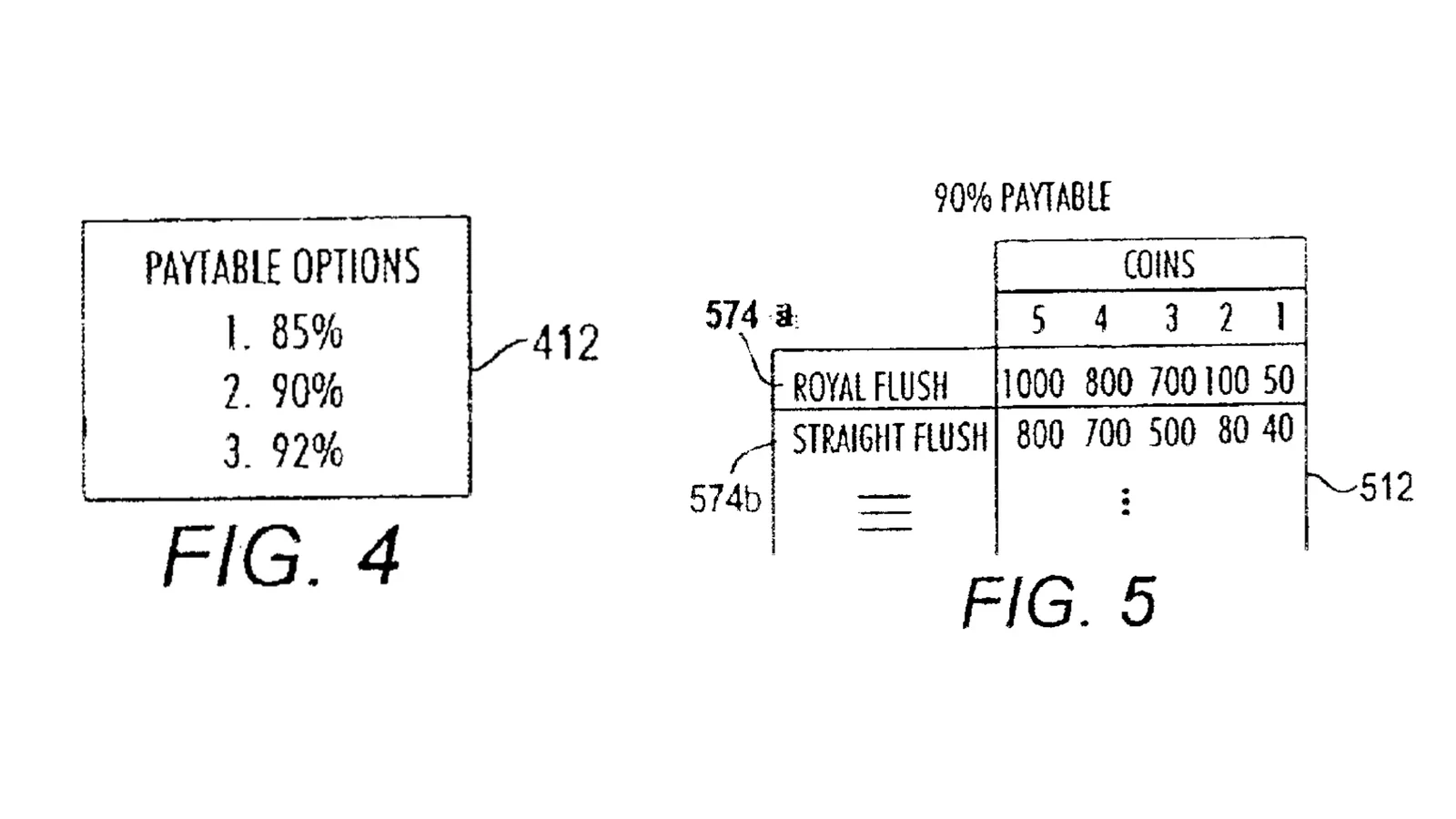
The idea of choosing a payout rate for the same game came first to offline slot machines rather than online. US Patent No. 6,802,778, “Gaming device and method with operator-set paytable,” which the US slot machine maker IGT provisionally filed in September 1999 and was granted on October 12, 2004, shows that structure in drawings. Patent Figure 4 displays three options, 85%, 90%, and 92%, side by side on a screen called “Paytable Options,” and Figure 5 shows the actual paytable of the “90% paytable” among them.
The background explanation in this patent document is interesting. It says that in games like video poker, where the probabilities of card combinations are fixed, the return rate can only be adjusted by changing the payout amounts, whereas an electronic slot machine can change the frequency of each outcome itself through what is called the virtual reel method. The fact that today’s online slot RTP versions are a structure with “the same paytable but different probabilities” is an extension of this principle. How symbol frequency is adjusted is covered in detail in the wiki’s virtual reels and reel strips entry.
The patent points out another important piece of context. A slot’s paytable must be approved by the regulator, and standards such as the minimum return rate differ by jurisdiction. For example, Nevada Gaming Commission Regulation 14.040 in the US requires every gaming device to theoretically return at least 75% on each bet. New Jersey sets the theoretical RTP of slot machine games at 83% or higher (N.J.A.C. 13:69E-1.28A), and Pennsylvania sets it at 85% or higher (4 Pa.C.S. 1207). To sell the same machine in several markets, it was more efficient to prepare multiple return rates from the start.
Why online versions multiplied – regulation and tax
Malta MGA – From 92% to 85%
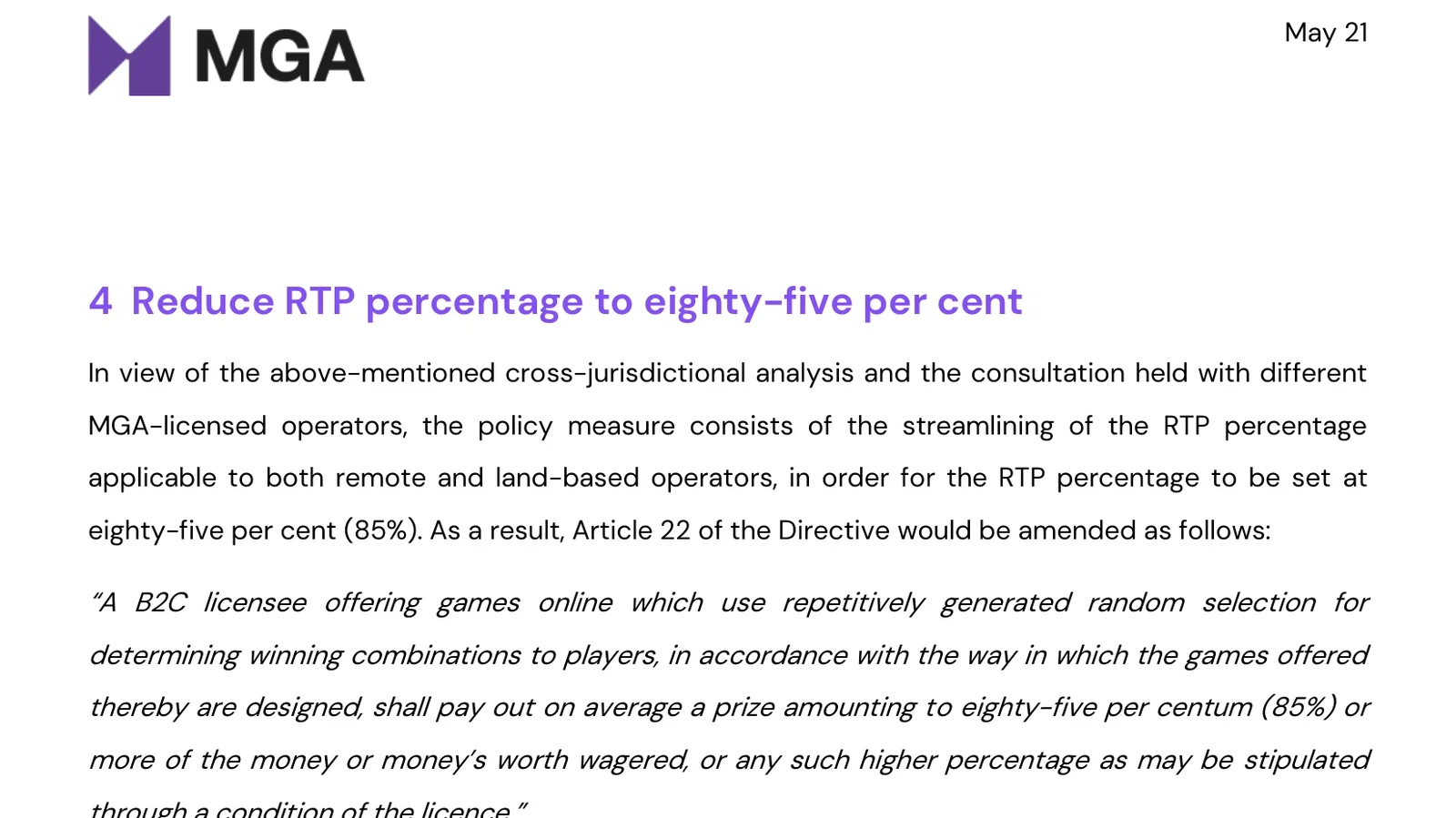
The best primary source on how RTP versions spread in the online slot industry is the “policy document on revising the minimum RTP” that the Malta Gaming Authority (MGA) published in May 2021. According to this document, Malta then required a minimum average RTP of 85% for land-based venues and 92% for online B2C operators. To remove this gap, the MGA decided to lower the online standard to 85% as well.
The industry opinion consultation results published in the document are a record of the industry itself explaining why RTP versions are needed.
- Every operator that responded said they would lower RTP if the standard were lowered. They added, however, that this would apply only to specific markets and specific games, not all games.
- The RTP range respondents gave was 85% to 96%. The explanation was that the lower end is used in jurisdictions where taxes make a lower RTP unavoidable, and the higher end in other markets.
- Opinions were raised that game suppliers must have the game re-certified for each new RTP level, and that this process takes several weeks and costs money. There was also an outlook that, as a result, versions would be added to only a small number of games.
- The report also included a concern that an excessively low RTP is a disadvantage when competing with illegal operators who pay no tax.
The comparative survey in the same document also summarizes the situation in other countries. The UK, Sweden, Spain, Denmark, Belgium, Gibraltar, and the Isle of Man were found not to set a specific minimum RTP percentage for online slots, and Italy was noted to require an RTP of 90% or higher for fixed-odds games. You can read about the Malta MGA licensing framework separately in the wiki.
Germany – A Tax on the Bet Amount
When Germany’s new Interstate Treaty on Gambling took effect on July 1, 2021, a ‘virtual slot machine tax’ was applied to online slots. The rate is 5.3%, but the tax base is the bet amount rather than profit (precisely, the bet amount minus the tax). Worked out, about 5.03% of the bet amount goes to tax.
Here is where the numbers show why RTP versions are needed. With a 96% RTP version, the operator’s theoretical share is 4% of each bet. But with taxes of about 5.03%, the operator is already in the red before counting any other costs. To keep operating while paying the tax, an operator has no choice but to pick a version with a lower RTP. This is the classic case the MGA document describes as “jurisdictions where taxes require a lower RTP.” The German regulator is covered in the wiki’s Germany GGL entry.
United Kingdom – 2026 remote gaming duty increase
In its response to the remote gambling tax consultation, published with the November 2025 Budget, the UK government announced that remote gaming duty will rise from 21% to 40% starting in April 2026. This tax applies to gross gaming revenue, not to the amount bet. An opinion piece claimed that some UK operators lowered the RTP settings of popular slots after the increase, but its author and method were not disclosed, so we have not carried over any specific figures here.
Instead of setting a minimum RTP, the UK requires information disclosure. RTS 3C of the UK Gambling Commission‘s remote gambling technical standards says players must be able to easily see RTP or win probability information, along with the house edge, before they place a bet. The implementation guidance explains that showing an “average theoretical RTP” is acceptable and that it can go in the game artwork, help text, or a how-to-play page.
Brazil – 85% Minimum and a Disclosure Requirement
Brazil set online game rules with Ordinance (Portaria) No. 1.207 of the SPA under the Ministry of Finance on July 29, 2024, specifying that each game must theoretically return at least 85% over its expected lifetime. Two days later, on July 31, Ordinance No. 1.231 required operators to disclose the theoretical RTP for each online game they offer. In effect, it set a minimum standard and a disclosure requirement at the same time.
Different Disclosure Methods by Provider
It is common across the industry that RTP versions exist, but how openly they are disclosed varies by provider. Here is how the four companies compare, based on their official materials.
Hacksaw Gaming – all versions listed on the official page
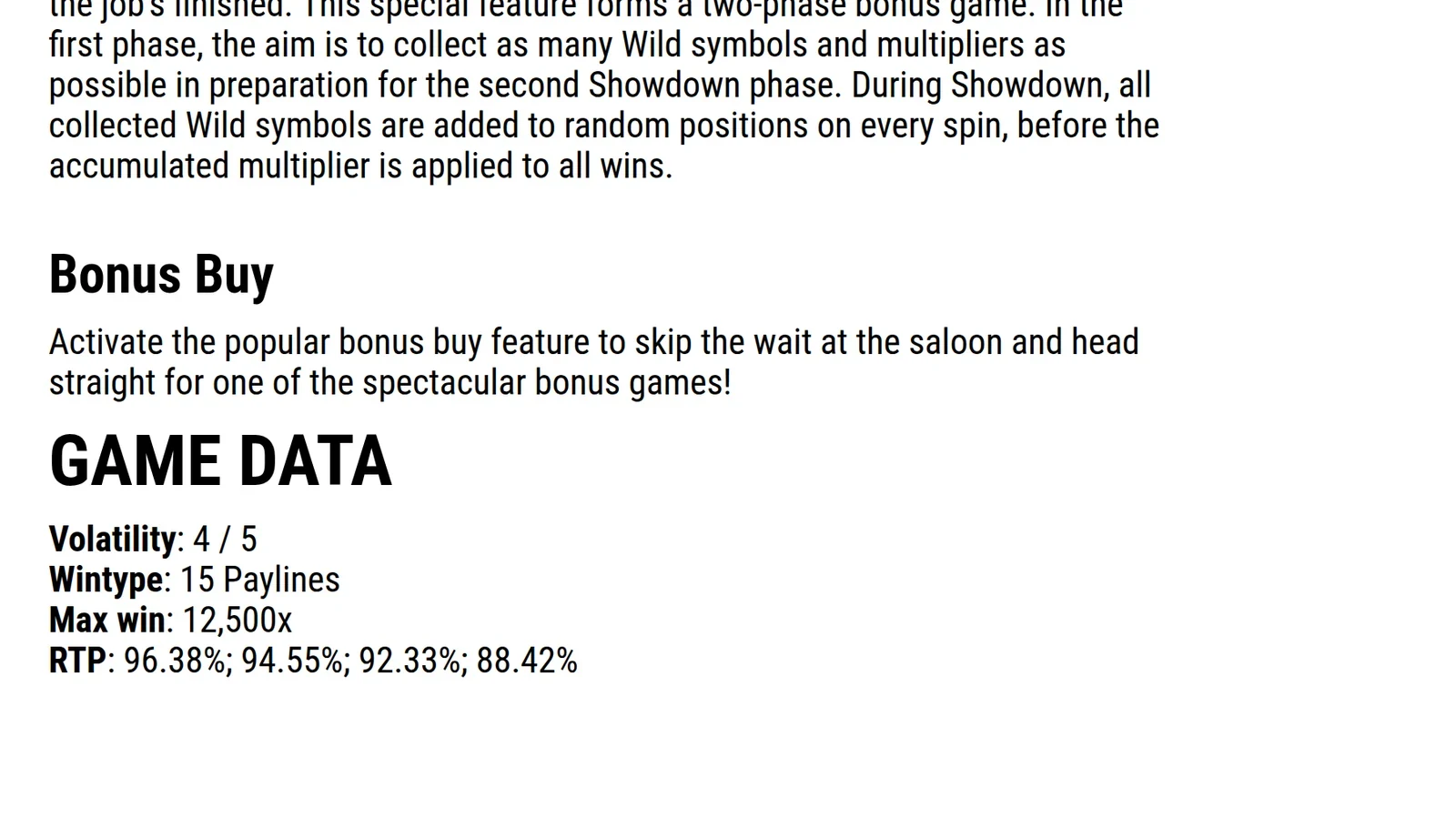
Hacksaw Gaming lists the RTP versions side by side, separated by semicolons, under “Game data” at the very bottom of the game’s intro page on its website. The values for the games we checked are as follows.
- Wanted Dead Or a Wild: 96.38%, 94.55%, 92.33%, 88.42% (volatility 4 out of 5, max 12,500x)
- Le Bandit: 96.34%, 94.23%, 92.17%, 88.36% (volatility 3/5, max 10,000x)
- Chaos Crew 2: 96.27%, 94.22%, 92.41%, 88.28% (volatility 5/5, max 20,000x)
- Chaos Crew: 96.30%, 92.40%, 88.40% (volatility 5/5, max 10,000x)
Most are set at four levels: the 96% range, 94% range, 92% range, and 88% range, with gaps of roughly 2 percentage points between levels. However, Chaos Crew, the first game in the series, has only three levels, with no 94% version. This means the number of prepared versions can differ from game to game.
Pragmatic Play – shown by mode inside the game
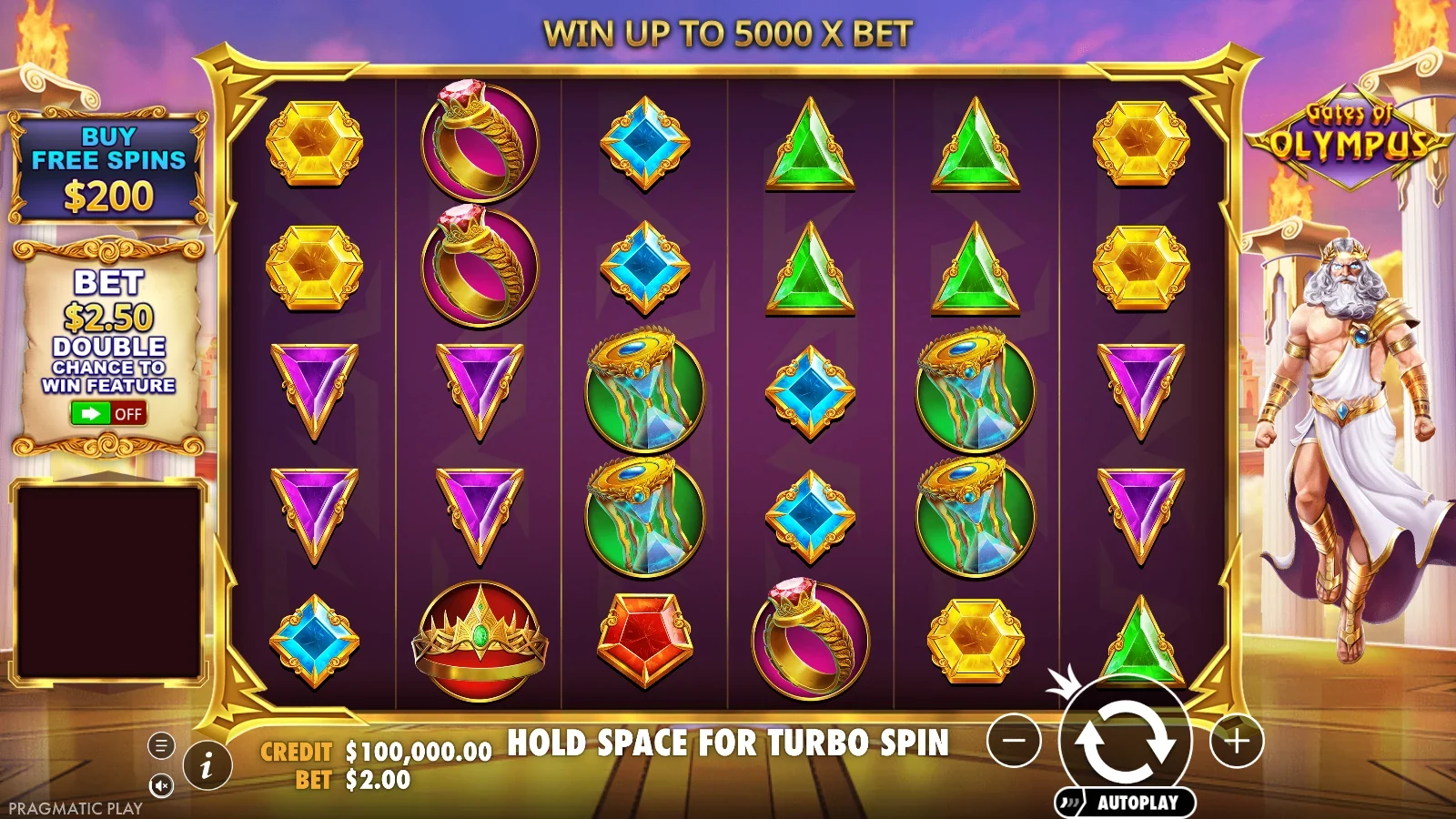
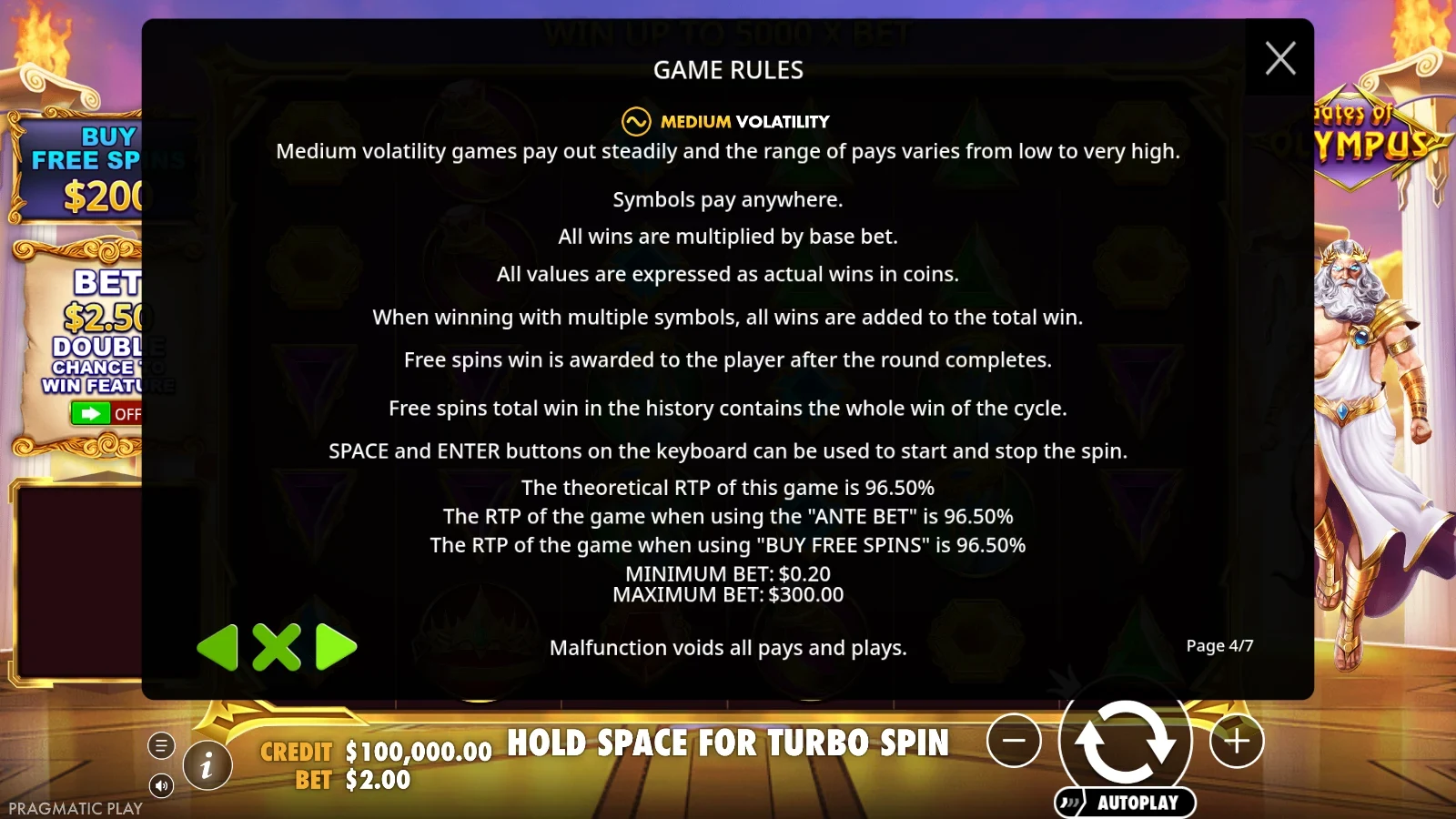
Pragmatic Play’s official game page shows only one RTP. The Gates of Olympus page lists only 96.50%. Instead, the in-game rules screen lists the RTP for each mode. The demo game’s rules screen shows, in order, a theoretical RTP of 96.50%, 96.50% with Ante Bet on, and 96.50% with Buy Free Spins.
What’s interesting is where this number comes from. Checking the screen configuration files that the Pragmatic demo game downloads, the rules screen sentence is stored as a template with a blank for the number, like ‘The theoretical RTP of this game is {0}%’. The number is filled in by settings the game server sends on first connection (the RTP for the regular, Ante and Buy modes). It is a structure that lets the same game files serve multiple RTP versions while the screen shows the number for the version actually set for that operator.
Cases where values differ by mode can also be confirmed in server settings. The server setting values for the Gates of Olympus 1000 demo were 96.50% for regular, 96.50% for ante bet, and 96.49% for free spins purchase. The difference is small at 0.01 percentage points, but it shows that a bonus buy and a regular spin use different math models. How to check the official figures of Pragmatic Play games yourself is covered separately in the Pragmatic Play game verification guide.
Play’n GO – “average RTP” and operator-configurable settings
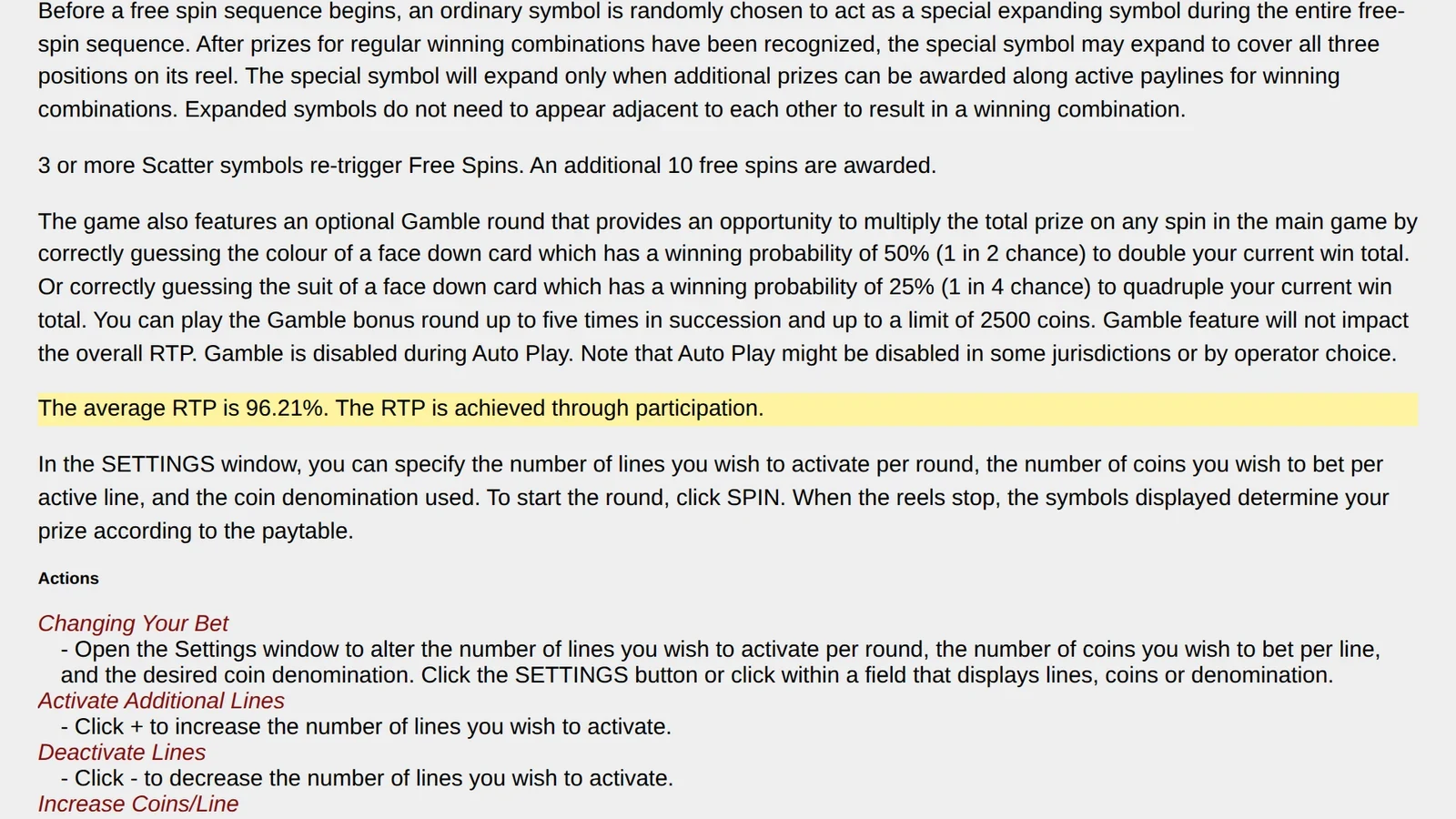
Play’n GO’s official game page has no RTP figure. Instead, the in-game help gives the RTP. The Book of Dead help loaded for the Malta jurisdiction says the average RTP is 96.21% and is achieved through participation. Checking the same way, Reactoonz was 96.51%, and Moon Princess and Rise of Olympus were 96.50%.
The data that the Play’n GO game launcher receives when it loads game information includes a list of items that the operator can adjust. In the Book of Dead list, ‘game.rtp’ appears alongside settings such as bet units and jackpots. This is a point where the system structure confirms that RTP is not a fixed value baked into the game but a setting that varies by operator. Play’n GO does not publish specific figures for lower versions on its official site, so this article does not list lower version values.
There is one more sentence worth noting in the Book of Dead help. It states that the gamble feature, where you stake your winnings and guess the card color or suit, does not affect the overall RTP. This is because gamble is designed as a fair bet with probabilities of exactly one half or one quarter and a payout that matches only that.
Nolimit City – Discloses Even the Base Game and Bonus Shares
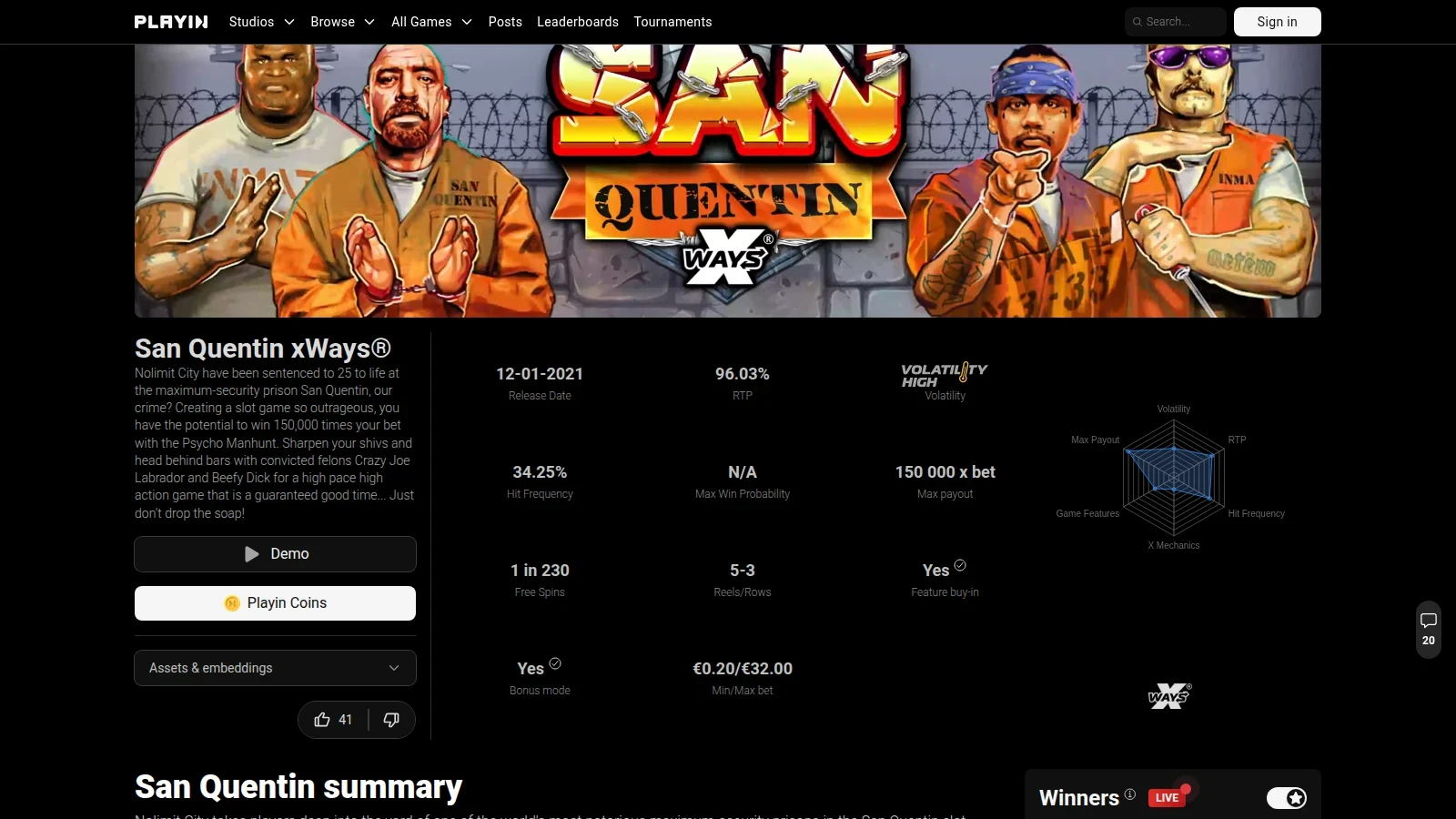
Nolimit City discloses fairly detailed math data on its official game pages, along with a single RTP. The data on the San Quentin xWays page shows RTP 96.03%, hit frequency 34.25%, free spins entry once every 230 spins, and max win 150,000x. The page data separately lists the RTP contributed by the base game as 58.74%. That means the remaining roughly 37.29 percentage points come from the bonus side. The figures for lower RTP versions were not found on the official page.
Case Study – The Four Faces of Wanted Dead Or a Wild
Let’s put numbers on the version differences using Wanted Dead Or a Wild, whose official page discloses all four versions. The house edge, which is 100% minus RTP, for each version is as follows.
- 96.38% version: house edge 3.62%, theoretical average loss of 36,200 KRW per 1 million KRW of total bets
- 94.55% version: house edge 5.45%, average loss 54,500 KRW
- 92.33% version: house edge 7.67%, average loss 76,700 KRW
- 88.42% version: house edge 11.58%, average loss 115,800 KRW
The RTP gap between the highest and lowest versions is 7.96 percentage points, but in terms of house edge, 3.62% versus 11.58% is a gap of about 3.2x. With the same graphics, the same bonus, and the same max 12,500x, the share the operator keeps in the long run differs by more than three times. To feel what an RTP difference means, read it as a multiple of the house edge, not as percentage points.
RTP, Volatility, Hit Frequency – Three Numbers That Move Separately
To understand RTP versions, you need to distinguish how RTP differs from other metrics. Putting three games side by side using data from the official NetEnt and Nolimit City pages makes the difference clear.
- Starburst: RTP 96.08%, hit frequency 23%, max 800x, page volatility figure 3.1
- Gonzo’s Quest: RTP 95.97%, hit frequency 41%, max 2,200x
- San Quentin xWays: RTP 96.03%, hit frequency 34.25%, max 150,000x, page volatility figure 13.43
The RTPs of the three games fall within 0.11 percentage points of each other. Yet hit frequency ranges from 23% to 41%, and max win differs by more than 180 times, at 800x versus 150,000x. The volatility figure that the two companies’ pages list in the same format also differs by more than four times, 3.1 versus 13.43. The exact definition of this figure is not disclosed, but it is clear that San Quentin xWays is a much rougher game.
To sum up, RTP is how much is returned, hit frequency is how often you win, and volatility is how far results swing from the average. Within the same RTP, wins can be split into small, frequent ones or concentrated into rare, large ones. The concepts of hit frequency and volatility can be found in the wiki’s hit frequency entry and volatility entry, respectively.
There is one more important point about RTP versions. Even providers that publish figures for each version, like Hacksaw Gaming, list only one value for volatility and max win. This means a lower RTP version does not officially change the volatility rating or the max win cap. What shrinks is the long-term average.
What RTP Does Not Tell You
In short sessions, luck covers up RTP differences
Let’s calculate with assumed numbers when an RTP difference is actually felt. Assume a game where the standard deviation of a single spin result is 10 times the bet (this is an assumed value for illustration), and compare the highest version (96.38%) and the lowest version (88.42%) of Wanted Dead Or a Wild at 1,000 won per spin.
- 1,000 spins (total bet 1 million KRW): the difference in expected loss between the two versions is 79,600 KRW. But the standard deviation of the result is about 316,000 KRW. The swing from luck is roughly four times the version difference.
- 100,000 spins (total bet 100 million KRW): the difference in expected loss grows to 7.96 million KRW. The standard deviation is about 3.16 million KRW, so the version difference is about 2.5 times the swing.
When the number of spins grows 100 times, the difference in expected loss grows 100 times, but the swing of luck grows only 10 times. So over a short stretch the version difference is barely visible, and over a long stretch the version difference decides the result. This is exactly what the law of large numbers says.
RTP Is Not a Promise About the “Next Spin”
RTP is only a theoretical value averaged over a huge number of spins. It does not mean that after a long losing streak the game is due to pay you back. Each spin is independent and is decided with the same probability regardless of what happened before. The fact that Pragmatic Play game files include a notice, for some jurisdictions, to the effect that “each spin is independent, and changes in on-screen presentation do not affect RTP” is in the same spirit. This misconception is well known as the gambler’s fallacy.
Theoretical RTP and actual RTP are different
The UK Gambling Commission separates the value set in a game’s design, the “theoretical RTP,” from the value calculated from actual payouts and bets on a live game, the “actual RTP.” Real-time RTP monitoring watches whether a live game’s actual RTP drifts far from its theoretical value. The number shown on the player’s screen is the theoretical RTP, and there is no reason an individual’s play history should match that number.
How to Check the RTP on Your Screen
Which version of a game you are actually playing must be confirmed inside the game screen itself, not on the provider’s official page.
- After opening the game, open one of the i button, menu, help, or game rules.
- Look for phrases like ‘Theoretical RTP’, ‘Return to Player’, or ‘average RTP’. For Pragmatic Play, it’s often on a later page of the rules screen; for Play’n GO, it’s often at the end of the game rules paragraph in the help section.
- For games with an ante bet or bonus buy, check whether the RTP is listed separately for each mode.
- Compare that number with the value on the provider’s official page. If it is lower than the official page value, a lower version is set.
- With a provider like Hacksaw Gaming that publishes a version list, you can also tell which step on that list you are on.
Points to Watch When Reading the Data
The Number on the Official Page Is Usually the “Highest Version”
Provider official pages and demo games are generally based on the highest version. The Pragmatic Play demo server we checked this time showed an RTP setting of 96.50% for Gates of Olympus in every case, even when we changed the jurisdiction value when loading it. There is no guarantee that the RTP you see in a demo matches the version actually offered.
Why the Same Game Shows Different RTP on Different Sites
On review sites and game listing sites, the RTP of the same game is often written differently. Usually neither one is wrong; they are simply listing different versions. For example, Book of Dead is 96.21% according to the official help, but some places present it with a 94% figure. When citing a number, first check which version that value belongs to and whether the source is the provider’s official material.
The Gaps and Number of Versions Differ by Game
As the Hacksaw Gaming example showed, the number and spacing of versions differ from game to game. Four steps spaced 2 percentage points apart are common, but some games have only three steps. Do not apply one provider’s practice directly to another provider or another game.
If you try a game in demo mode, first check where and in what wording the RTP is written on the rules screen, whether the value is split by mode, and how volatility and max win are displayed. Once you know that location, you can read the version currently running on any screen right away.
FAQFrequently Asked Questions
If it’s the same game but the RTP is different, are the graphics and features different too?
No. An RTP version keeps the screen, rules, bonus structure, and max win the same and changes only the probability settings behind them. The official Hacksaw Gaming page also lists several RTP values by version but only one value each for volatility and max win. That is why you cannot tell the version just by looking at the screen.
Who decides the RTP version?
The provider creates several versions and has them certified by testing labs and regulators, and the operator that actually offers the game picks one of them. The fact that Play’n GO launcher data includes ‘game.rtp’ as an operator configuration item shows that structure. In the Malta MGA consultation, industry opinions also noted that each new RTP level requires re-certification, which takes several weeks.
Why do providers make lower RTP versions?
The biggest reason is taxes and regulation by country. When a tax of about 5% is applied to the bet amount, as in Germany, the operator’s share on a 96% RTP version becomes smaller than the tax. In the MGA consultation as well, operators stated that they use lower versions in jurisdictions where taxes require a lower RTP.
Is there anywhere with a legally set minimum RTP?
Yes. In the US, Nevada requires at least 75% on each bet, New Jersey requires at least 83% for slot machine games, and Pennsylvania requires at least 85%. Malta announced a policy in May 2021 to lower its online standard from 92% to 85%, and Brazil set a minimum of 85% for online games in July 2024. The UK, by contrast, requires disclosure of RTP information instead of a minimum rate.
Does RTP change if I use bonus buy or ante bet?
It depends on the game. In Gates of Olympus, the regular mode, ante bet, and free spins purchase are all the same at 96.50%. In contrast, in Gates of Olympus 1000, only the free spins purchase is 0.01 percentage points lower at 96.49% according to the demo server settings. The most accurate approach is to check whether the rules screen lists RTP separately for each mode.
Can I win if I play a higher RTP version?
No. If RTP is below 100%, the long-term expected value is a loss in any version. A higher version only means you lose less on average when betting the same amount, and in short sessions the influence of luck is much larger than the version difference.
Which version is the RTP listed on AI Slot?
The RTP on AI Slot’s free slot pages is based on data published by the provider, but depending on the provider, only one of several versions may be shown. The game actually running at an operator may also be a different version, so check the exact figure on the info screen inside the game itself.
Related reads
The basic definition and formula of RTP are in the wiki’s RTP entry, and the comparison of average losses by version is in the RTP version entry. If you want to know how to check official figures yourself, see the Pragmatic Play game verification guide, and if you are looking for low-volatility games, the low-volatility slot ranking guide is a good companion. You can open San Quentin xWays and Wanted Dead Or a Wild, both covered in this article, as demos on AI Slot and check the RTP shown on their rules screens yourself.
Sources: IGT US Patent 6,802,778; Malta Gaming Authority (MGA) policy document on revising the minimum RTP (May 2021) and 2016 notice on amending the remote gaming regulations; Nevada Gaming Commission Regulation 14.040; New Jersey N.J.A.C. 13:69E-1.28A; Pennsylvania 4 Pa.C.S. 1207; UK Gambling Commission RTS 3C and real-time RTP monitoring terminology; UK government response on remote gambling taxation (November 2025); Taylor Wessing (German virtual slot machine tax); Demarest (Brazil Portaria 1.207 and 1.231); official Hacksaw Gaming game pages; official Pragmatic Play pages and demo game rules screens; official Play’n GO in-game help; official Nolimit City and NetEnt game pages