



Cluster pays full breakdown – from adjacency rules to Gemix, Aloha, and Sugar Rush
Cluster pays is a system that pays based on the size of a cluster of the same symbol touching horizontally and vertically. We’ve organized the judging rules, grid sizes, the history going back to 2004, and why it is always used together with cascades (tumbles), using providers’ official materials.

Key takeaways
- Cluster pays sets the payout by the size of a cluster of the same symbol touching horizontally or vertically, and most games do not count diagonal connections.
- The name “Cluster Pays” came from NetEnt’s Aloha! Cluster Pays in March 2016, but the same rule already existed in Play’n GO’s Gemix in December 2014 and, according to Big Time Gaming’s account, in Chain Reactors in 2004.
- Because a cluster is hard to complete in one go, most cluster slots also use cascades (tumbles), while early NetEnt games used sticky respins instead of cascades.
- The minimum size (5, 6, or 9) and the grid (from 5×3 to 9×9, and even variable ones) differ by game, so check the game info screen first.
Cluster Pays is a slot winning method with no fixed paylines, where payouts are based on the size of a cluster of the same symbol touching horizontally or vertically. Usually 5 or more must be connected to win, and symbols touching only diagonally are not part of the cluster. Most cluster slots also use a cascade (tumble) feature that removes the winning cluster and drops in new symbols.
This article takes apart cluster pays starting from the rules for judging a win. In order, it covers what “touching” means exactly, why grid size matters, how this system spread from grid games around 2004 through NetEnt’s trademarked name to Pragmatic Play, Nolimit City, and Hacksaw Gaming, and why clusters struggle to work without cascades. If you only want a quick definition of the terms, you can start with the cluster pays entry in the wiki.
Three judging rules – neighbors, minimum size, cluster size
It is easier to understand a cluster slot screen as a checkerboard-like grid rather than reels. When a spin ends, the game scans the whole grid to find clusters of the same symbol connected together. Almost all games use the same three rules here.
- Definition of a neighbor: A cell’s neighbors are only the four cells above, below, left, and right. Diagonal cells that only touch at a corner are not neighbors.
- Minimum size: A cluster must reach a set number of symbols or more to win. 5 is the most common, but it varies by game.
- Cluster size payouts: even for the same symbol, a bigger cluster pays more. The paytable lists payouts by size tier, such as “5, 6, 7 … 15 or more.”
Number of neighbors – the grid in numbers
Turning the neighbor rule into numbers shows what a grid is like. A 7×7 grid has 49 cells. The four corner cells have 2 neighbors, the 20 edge cells excluding corners have 3, and the 25 inner cells have 4. Counting pairs of touching cells gives 7 rows × 6 pairs horizontally and 7 columns × 6 pairs vertically, for 84 pairs in total.
Counted the same way, a 6×5 grid has 49 pairs, an 8×8 grid has 112 pairs, and a 9×9 grid has 144 pairs. The bigger the grid, the more paths a cluster can grow along, and the more room there is for several clusters to form at once on one screen. But more cells does not make wins easier. Providers tune the number of symbol types, their appearance ratios, and the minimum size together to balance the overall math.
What changes when diagonals are excluded
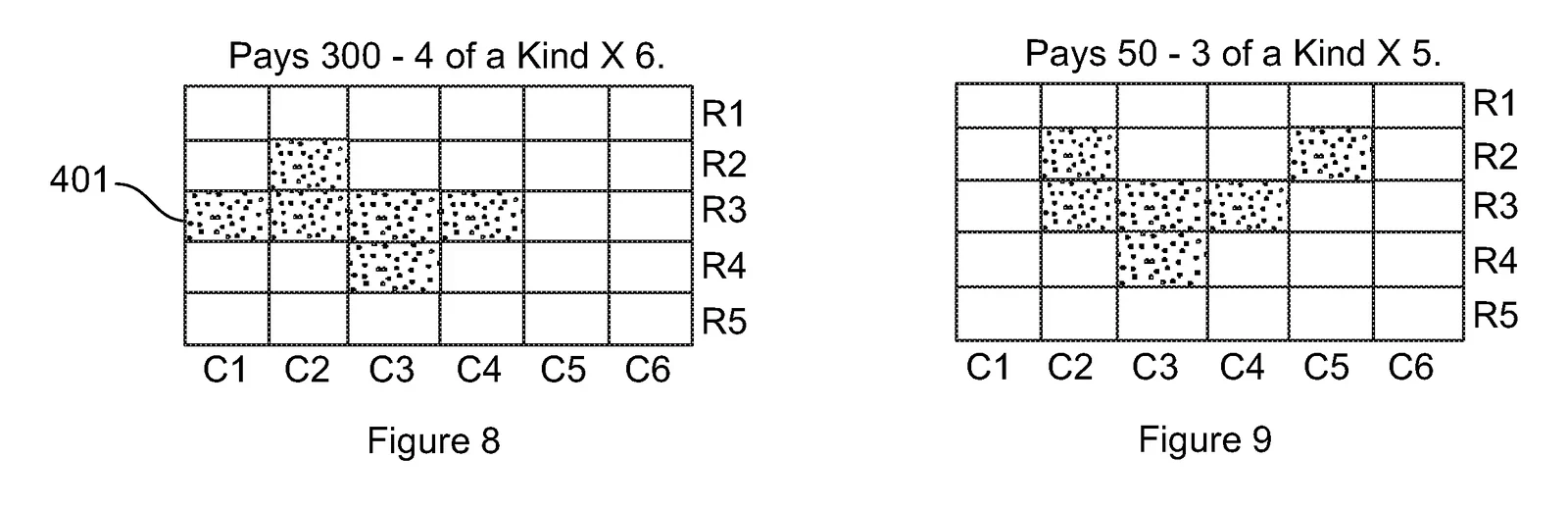
The patent drawings Aristocrat filed in the US are the cleanest public material showing this rule. The patent defines a cluster as “a group of symbols connected so that each shares at least one edge.” In drawing 9, next to a 5-cell cluster spanning columns C2 to C4, there is one more of the same symbol at the top of column C5. This symbol touches one cell of the cluster only at a corner, so it is not part of the cluster. To the player’s eye it looks almost attached, but it drops out of the calculation.
Grid size sets the rhythm of the game
Cluster game grids are more varied than you might expect. The main sizes confirmed from official information are as follows.
- 5×3: a regular 5-reel screen with only cluster evaluation added (NetEnt Berryburst)
- 5×5: NetEnt Wild Worlds, and the early grid game Chain Reactors
- 6×5: NetEnt’s first cluster game, and Hacksaw Gaming’s cluster games
- 6×6: Nolimit City’s first cluster game
- 7×7: many of the flagship cluster games from Play’n GO and Pragmatic Play
- 8×8: Pragmatic Play Gems Bonanza
- 9×9: the Red Tiger Clusterbuster series
- Variable: Big Time Gaming Megaclusters (4×4 up to 8×8 in the base game, 16×16 in free spins)
On a small grid, clusters quickly hit the edge of the screen, which limits their size. A large grid has room for big clusters, but symbols are more spread out, and spins where nothing happens can become more frequent. 7×7 is common because it is a compromise between these two problems.
Origins – From grid games to the name “cluster pays”
Chain Reactors in 2004
Grid games combining clusters and cascades already existed in the mid-2000s. On its official game page, Big Time Gaming introduces the cluster and reaction genre as having started in 2004 with “Chain Reactors.” The rules page for this game, which was offered at online casinos at the time, states that “a cluster is 5 or more of the same symbol connected horizontally or vertically” and that “symbols connected diagonally do not count as a win.” When winning symbols disappear, new symbols drop from above, repeating until there are no more wins. It is essentially the same structure as today’s cluster slots. However, sources disagree on the developer, listing both Cozy Games and IGT.
Play’n GO’s experiment – from 3 in a row to clusters of 5
The direct root of modern online cluster slots is Play’n GO. Energoonz, released on November 28, 2013, is the game Play’n GO counts as the first in the Reactoonz series. However, the official description says the base game’s win condition is “3 or more in a row horizontally or vertically.” It was closer to a match-3 puzzle than a cluster game, and the bonus game used a system where 5 or more anywhere on the grid win. The multiplier rises with each cascade, and there was also a rule paying 1,000x the bet for clearing the grid completely.
The version with today’s cluster rules fully in place is Gemix, released on December 1, 2014. Play’n GO’s official description introduces Gemix as a cascading slot on a 7×7 grid and states the win condition as “5 or more of the same symbol touching horizontally or vertically.” Winning symbols disappear and new symbols drop in, repeating until there are no more wins. That was more than a year ahead of NetEnt.
A patent from the same period – Aristocrat
Land-based slot manufacturers were also researching cluster payouts. Aristocrat Technologies Australia’s US Patent No. 10,964,173, “Gaming method and apparatus using cluster-based wins,” has a priority date of September 29, 2014, was filed on September 29, 2015, and was granted on March 30, 2021. The calculation in this patent differs slightly from online cluster slots. A cluster must span at least 2 columns, and the payout is “a base payout set by the number of columns spanned × the number of cells in the cluster.” The patent text says there is no minimum cell count, so even a 2-cell cluster is possible.
The name NetEnt gave it – Cluster Pays™
NetEnt is the company that made “cluster pays” an industry-standard term. According to NetEnt’s official game information, the release date of Aloha! Cluster Pays is March 22, 2016. The next day, iNTERGAME reported the game as the first to use NetEnt’s new cluster pays mechanic. NetEnt still writes it with a trademark symbol on its official page, as Cluster Pays™.
So the question “what was the first cluster slot?” has two answers. By name and trademark, NetEnt was first in March 2016. By rules, Gemix in December 2014 came earlier, and Chain Reactors in 2004 even earlier. Some review sites call NetEnt “the first” because they go by the name.
Spread – how each provider adopted clusters
Megaways spread through licensing from Big Time Gaming, but no record has been found that cluster pays spread through that kind of licensing deal. Other providers also use “cluster pays” or “cluster payouts” as a generic term, and differentiated themselves by adding features with their own unique names.
On September 21, 2017, NetEnt released The Legend of Shangri-La as “the next adventure in the Cluster Pays series,” followed by Berryburst on a 5×3 screen on August 23, 2018, and Wild Worlds on a 5×5 screen on April 9, 2019. Play’n GO popularized clusters with Reactoonz on October 23, 2017.
Pragmatic Play joined in earnest in May 2020 with the 7×7 Fruit Party, and in June 2022 added a new device, multiplier spots, with Sugar Rush. That same June, Big Time Gaming introduced a new format called “Megaclusters” with its first grid game, Star Clusters Megaclusters. Red Tiger released the 9×9 grid Dragons Clusterbuster on March 3, 2022, and Nolimit City used cluster pays for the first time with The Border on September 13, 2022. Hacksaw Gaming released the 6×5 grid Le Bandit in August 2023.
Timeline recap
- 2004: Chain Reactors, an early grid game using clusters of 5 or more across and down, plus cascades (per Big Time Gaming’s description)
- November 2013: Play’n GO Energoonz, a grid cascade game (the base game uses a 3-in-a-row method)
- September 2014: Aristocrat cluster payout patent priority date (registered in the US in March 2021)
- December 2014: Play’n GO Gemix, clusters of 5 or more on a 7×7 grid, with cascades
- March 2016: NetEnt Aloha! Cluster Pays, the name ‘Cluster Pays™’ appears
- October 2017: Play’n GO Reactoonz, popularizing 7×7 cluster cascades
- May 2020: Pragmatic Play Fruit Party, 7×7 clusters with multipliers
- June 2020: Big Time Gaming Star Clusters, Megaclusters format
- March 2022: Red Tiger Dragons Clusterbuster, a 9×9 grid with a locked block
- June 2022: Pragmatic Play Sugar Rush, a multiplier spot feature
- September 2022: Nolimit City The Border, the company’s first cluster game
- August 2023: Hacksaw Gaming Le Bandit
- March 2024: Pragmatic Play Sugar Rush 1000, raising the multiplier spot cap to 1,024x
Why clusters go hand in hand with cascades
There is a structural reason why most cluster slots use cascades.
First, clusters are hard to form. A payline slot only needs 3 symbols lined up on a set line, but a cluster needs 5 or more of the same symbol connected without a break. On a grid where symbols drop at random, it is rare for such a cluster to complete in a single drop. Cascades refill the grid several times within one bet, which increases the chances of a cluster forming.
Second, it is clear what gets removed. In a paylines game, using cascades requires separately deciding which symbol on which line to remove, but in a cluster game the winning cluster itself is the cells to remove. When symbols from above drop into the vacated spaces, the remaining symbols can touch in new ways and form the next cluster.
Third, cascades become the stage for multiplier mechanics. Sugar Rush marks the spot where a winning symbol burst, and if that spot bursts again in the same spin, it adds a 2x multiplier and then doubles it with each burst. Doubling seven times, from 2x to 4x to 8x and on, reaches the official cap of 128x. Without cascades, the same spot would never burst twice.
There are exceptions. Aloha! Cluster Pays used a “Sticky Win Re-spin” instead of cascades. When a cluster win lands, this feature triggers at random: the winning symbols are locked in place and only the rest of the grid is spun again. If the cluster grows, those cells are locked and spun again too, and it ends when the cluster stops growing or fills the screen. The goal of giving a cluster a “second chance” is the same as with cascades. Only the method was different.
Key games in detail
NetEnt’s first cluster game – 6×5 and a 9-symbol minimum
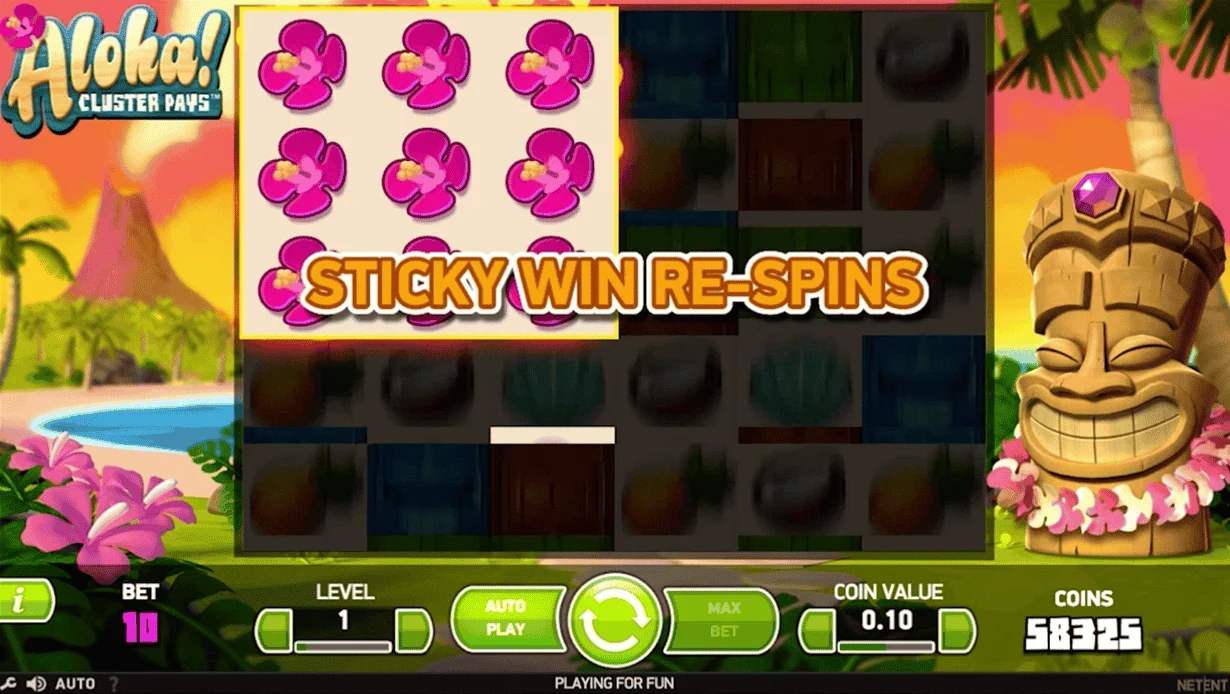
Aloha! Cluster Pays uses a 6×5 grid. According to NetEnt’s official information, its RTP is 96.42%, hit frequency is 21%, and max win is 700x the bet. Review sites explain that a win requires 9 or more of the same symbol touching each other. On a 30-cell grid, 9 is a fairly high bar. In exchange, the Sticky Win Re-spin and substitute symbols help the clusters grow. Free spins are awarded as 9 to 12 spins for 3 to 6 free spin symbols, and during free spins a “Symbol Drop” removes the low-paying symbols.
7×7 alien grid – a feature built up with a gauge
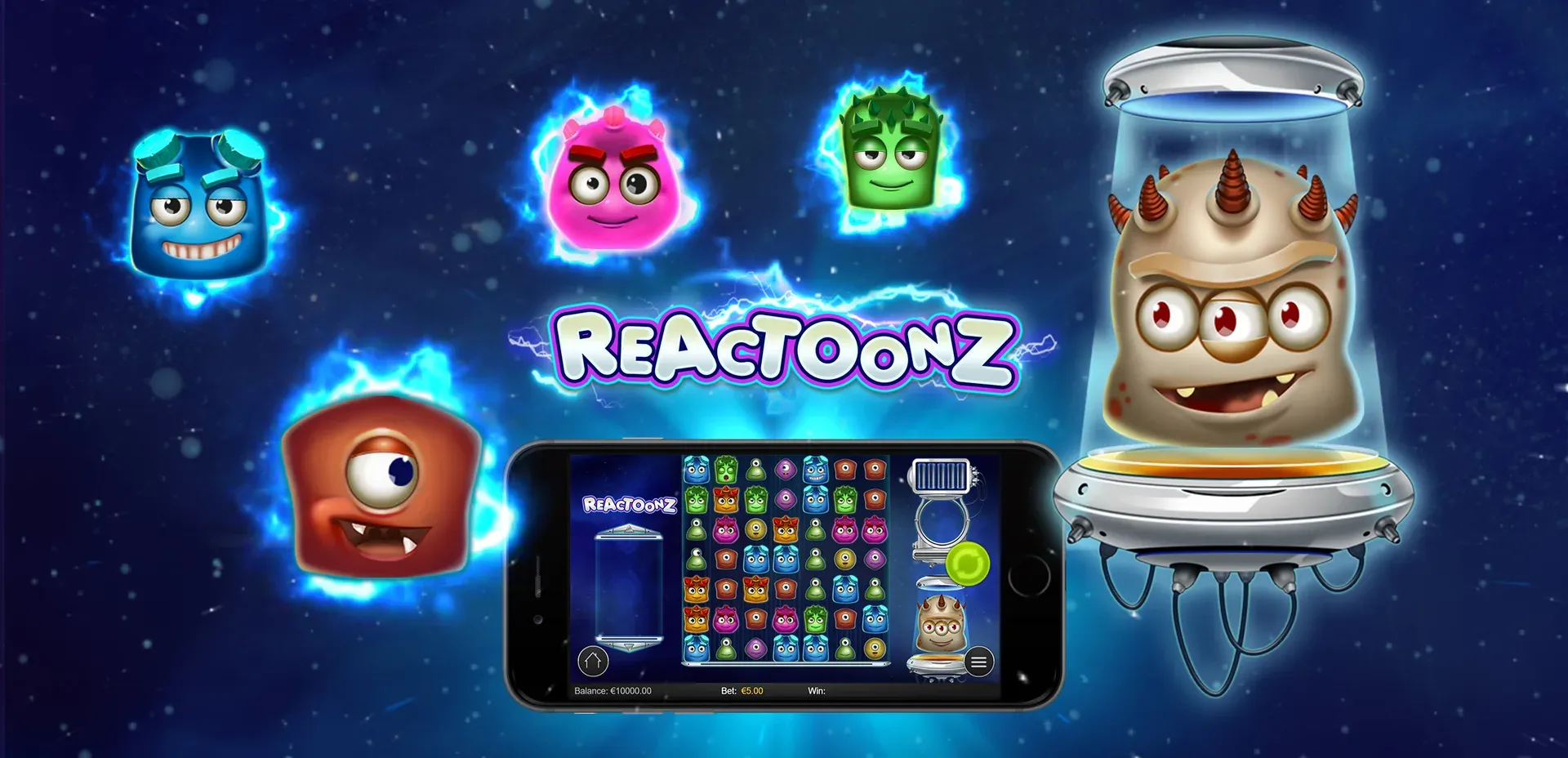
In Reactoonz, 5 or more of the same alien touching on a 7×7 grid wins. Winning aliens disappear and new aliens drop in from above. According to Play’n GO’s official description, each winning cluster charges energy for the giant alien Gargantoon, and when the gauge is full, Gargantoon leaps into the center of the grid and triggers up to five features in a row. It is a design that uses the number of cascades and clusters themselves as a “resource.” According to industry information, max win is 4,570x.
The multiplier spots on the candy grid
Sugar Rush is a 7×7 cluster game announced by Pragmatic Play on June 30, 2022. According to Pragmatic’s official description, clusters of 5 to 15 or more pay up to 150x in the base game, with the multiplier spot feature seen above. 3, 4, 5, 6, or 7 scatters award 10, 12, 15, 20, or 30 free spins respectively, and in free spins the marked spots and multipliers persist throughout the round. The official RTP is 96.50%, and according to industry information, max win is 5,000x. Sugar Rush 1000, released in March 2024, keeps the same structure but raises the multiplier cap to 1,024x.
Nolimit City-style clusters – xCluster
In The Border, 5 or more symbols touching horizontally or vertically on a 6×6 grid win. According to Nolimit City’s official information, the release date is September 13, 2022, RTP is 96.17%, hit frequency is 29.58%, and max win is 44,288x the bet. On top of a cascade where new symbols drop into the spots of burst clusters, Nolimit City’s x-mechanics are layered in, such as the xBomb wild, which blows up surrounding symbols and raises the multiplier of the next cascade. It even got its own dedicated feature named xCluster.
Megaclusters where clusters split apart
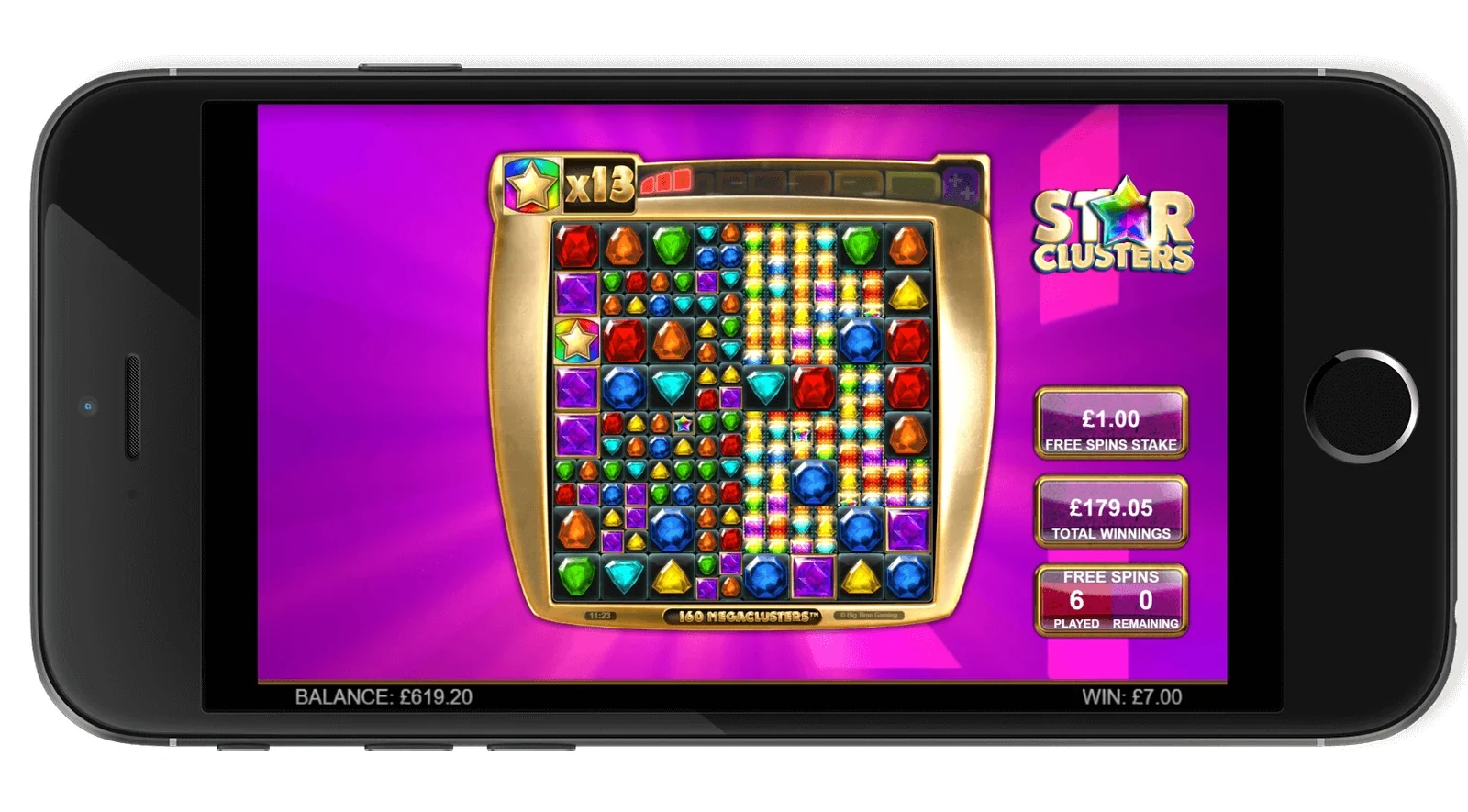
Star Clusters Megaclusters chose to “split” clusters rather than “grow” them. According to Big Time Gaming’s official description, Megaclusters is a format that splits winning symbols to create new ones; in the base game a 4×4 grid expands up to 8×8, and in free spins up to 16×16, placing up to 256 symbols on one screen. The official RTP is 96.54%. As the company that created Megaways, it carried the idea of “changing the number of grid cells” over to clusters.
The locked egg at the center of the 9×9 grid
Dragons Clusterbuster has a locked 3×3 “dragon egg” at the center of the 9×9 grid. Red Tiger calls this the Clusterbuster. Each time a winning cluster forms next to the egg, the outer cells of the egg break, and when all of them are broken, a hidden feature opens. According to the official information, the release date is March 3, 2022, RTP is 95.78%, hit frequency is 35.04%, and max win is 7,931x.
How providers interpret it differently
Even under the same “cluster” label, each provider emphasizes something different.
- NetEnt: an early approach that grows clusters through respins instead of cascades, with a high minimum size
- Play’n GO: the “grid slot” line combining cascades, meters, and grid-change effects
- Pragmatic Play: the formula of adding multipliers (random multipliers, multiplier spots) to a standard 7×7 grid
- Big Time Gaming: Megaclusters, which split winning symbols to grow the grid itself
- Red Tiger: the Clusterbuster, which breaks locked blocks to open features
- Nolimit City: layering x-mechanics like xBomb and xCluster on top of cascades
- Hacksaw Gaming: marking winning cells on a 6×5 grid and later converting them into rewards
- Aristocrat patent: a variant calculation method that sets the payout by the number of columns a cluster spans
The minimum size isn’t fixed either. Reactoonz, Sugar Rush, and The Border use 5, Pragmatic’s Candy Jar Clusters uses 6 according to its official description, and Aloha! Cluster Pays uses 9 according to reviews. That is why you should first check from which count a win starts on the game info screen. The background on why each provider uses different feature names is covered in the wiki’s provider-specific mechanics entry.
Clusters Through AI Slot Data
Games per provider
Top 5 games by max win
- Crystal Towers - Big Time Gaming, Max 90,050x, RTP 96.37%
- Epic Ze Zeus - Hacksaw Gaming, Max 50,000x, RTP 96.22%
- Sugar Rush Super Scatter - Pragmatic Play, Max 50,000x, RTP 96.58%
- Trigger Happy - Big Time Gaming, Max 50,000x, RTP 96.58%
- Lure of Fortune - Relax Gaming, max 50,000x, RTP 96.1%
Features that often appear together
Looking at the cluster games registered on AI Slot by provider, Play’n GO and Pragmatic Play have the most, followed by ELK Studios, PG Soft, Hacksaw Gaming, and Yggdrasil. The most common accompanying feature is tumble, followed by free spins and multipliers. The earlier point that clusters go hand in hand with cascades shows up in the data too. Among games with a fixed grid size, 7×7 is the most common. By release year, new cluster games have increased sharply since 2020.
What to watch for when reading cluster game info
Hit frequency is counted per spin
Dragons Clusterbuster’s official hit frequency is 35.04%, and Aloha! Cluster Pays is 21%. This figure usually means the share of spins that produced at least one win. Even if cascades burst clusters five times, it counts as one spin. A screen that bursts often does not mean the actual return is that big. The exact meaning of hit frequency is covered in the wiki’s hit rate entry.
Max wins of early and recent games are hard to compare
NetEnt’s early cluster games had an official max win in the range of 600x to 1,300x. By contrast, games from the 2020s range from 5,000x to over 40,000x. The cluster method itself did not change; the difference comes from multiplier mechanics and volatility design. Don’t generalize from the numbers alone that cluster games “hit big” or “hit small.”
There are several RTP versions
Hacksaw Gaming’s official page lists four RTPs for Le Bandit: 96.34%, 94.23%, 92.17%, and 88.36%. Play’n GO and Pragmatic games are also supplied in different RTP versions depending on the operator. Even the same game can have a different RTP depending on where you access it, so it is a good habit to check the actual value on the in-game info screen.
Beware the diagonal illusion
On a cluster screen the symbols are packed tightly, so symbols touching diagonally can easily look like a cluster. But almost all games only count horizontal and vertical connections. When you try a demo, first observe which cells the win highlight groups together, from what minimum count a win starts, and how multipliers or meters change after cascades.
FAQFrequently Asked Questions
What is the difference between cluster pays and scatter pays?
Scatter pays (pay anywhere) win as soon as the symbol count is met, wherever the same symbols are on the screen. Cluster pays require the same symbols to be connected to each other horizontally or vertically. Even with the same 8 symbols, if they are scattered, it is a win in scatter pays but may not be in cluster pays.
What was the first cluster pays slot?
The name “Cluster Pays” was first used in NetEnt’s Aloha game in March 2016. However, games with the same rule existed before that. Play’n GO’s Gemix used a 7×7 grid and clusters of 5 or more in December 2014, and Big Time Gaming names Chain Reactors from 2004 as the start of the genre.
Do diagonally touching symbols count toward a cluster?
In most games, no. Only symbols that share an edge, above, below, left, or right, count as connected. The rules of the early grid game Chain Reactors also state that a diagonal connection is not a win.
From what count does a cluster win?
5 is the most common minimum. But some games require 6, and others require 9 or more, like NetEnt’s Aloha on a 6×5 screen. Just check the smallest cluster size in the in-game paytable.
Do all cluster games have tumbles?
Most have them, but not all. NetEnt’s early cluster games used a respin that locks the winning symbols and spins the rest again, instead of cascades. Whether it is a cascade or a respin, the purpose is the same: giving the cluster one more chance.
Do bigger grids produce more wins?
Not necessarily. More cells mean more room for clusters to form, but providers tune symbol types, ratios, and minimum size together to balance the math. For actual hit frequency and RTP, the official game information is the accurate source.
Related reads
The history of the cascade feature, which moves as one with clusters, is covered in the “Tumble Full Breakdown” guide, and the story of another mechanic whose grid size changes with every spin is covered in the “Megaways Full Breakdown” guide. If you want to check the cluster rules yourself, start by opening the demos of Reactoonz or Sugar Rush on the 7×7 grid, and it is also worth comparing them with the originals, Gemix and Energoonz. Each provider’s personality shows at a glance if you spin Fruit Party, The Border, Star Clusters Megaclusters, Dragons Clusterbuster, and Le Bandit in turn.
Sources: NetEnt official game information (games.netent.com), Play’n GO official game pages (playngo.com), Pragmatic Play official game pages (pragmaticplay.com), Nolimit City official game information (nolimitcity.com), Red Tiger official game information (redtiger.com), Big Time Gaming official game pages (bigtimegaming.com), Hacksaw Gaming official game pages (hacksawgaming.com), US Patent US 10,964,173 B2 (Aristocrat), iNTERGAME (2016.3.23), iGaming Business (2016.3.29), Yogonet (2022.6.30), World Casino Directory, Gamebookers casino game rules page, OLBG