



A complete history of progressive jackpots – from Megabucks to Mega Moolah and link jackpots
A progressive jackpot grows as part of each bet is added every time you play. This guide covers how it works and its history in one place, from Megabucks in 1986 to the online record race, link jackpots and must-hit jackpots.


Key takeaways
- A progressive jackpot is one where part of each bet is added and the amount grows until it is won, then returns to the seed amount. NetEnt’s Divine Fortune Gold contributes 3.7% of each bet and sets aside 20% of that for the next seed.
- The first wide-area progressive was IGT Megabucks, launched in Nevada in March 1986, and the Guinness record for the largest slot machine win is 39,713,982.25 dollars from Excalibur in 2003.
- The Guinness-listed online record is Mega Moolah’s 17,879,645 euros from 2015, but the highest publicly reported amount is 38,461,200.95 euros on Wow Pot Wish Wheel in December 2023.
- Jackpots are divided into stand-alone, link (local) and wide-area depending on how widely they are pooled, and a must-hit-by jackpot is guaranteed to drop once it reaches a hidden amount set at random at each reset.
A progressive jackpot is a jackpot where a set percentage of each bet is added every time the game is played, so the amount keeps growing until someone wins, and after a win it returns to a set starting amount (the seed). Unlike a fixed jackpot whose amount is set from the start, its defining feature is that the number on screen rises in real time.
This article first explains how a progressive jackpot collects its money, how far it is linked and when it drops, then follows its history. It starts with IGT Megabucks in Nevada in 1986 and covers the online records set by NetEnt Mega Fortune and Microgaming Mega Moolah, as well as link jackpots such as Aristocrat Lightning Link and Macau’s Duo Fu Duo Cai. If you just want a quick look at the main jackpot categories, you can start with the jackpot types entry in the wiki.
What is the difference between fixed and progressive jackpots?
Not every slot that says “jackpot” on screen has the same kind of jackpot. The first thing to tell apart is whether the amount is fixed or keeps growing.
- Fixed jackpot: The amount is set as a multiple of your bet. Whoever wins, whenever they win, gets the same multiplier.
- Progressive jackpot: part of each bet builds up in the jackpot pot, and the winner receives everything accumulated up to that point. After a win, it builds up again from the seed amount.
Even within the same series, the two are split. According to official NetEnt information, the jackpots in Divine Fortune Black, released in May 2025, are all fixed: Minor 25x, Major 250x, Mega 2,500x. By contrast, the Mega jackpot in the original Divine Fortune, released in January 2017, and in Divine Fortune Gold, released in April 2026, is a progressive that keeps growing. NetEnt’s Grand Spinn, released in July 2019, also uses fixed jackpots: Mini 40x, Midi 200x, Mega 10,000x (based on bet level).
Megapots, which Big Time Gaming introduced in April 2025 with Big Bucks Deluxe, carries the jackpot name but works differently. Public materials describe three prize tiers (Mini, Midi and Mega) that change at random on each spin, and there is no mention of other players’ bets building up the prize. In other words, a game with “jackpot” or “pot” in its name is not necessarily progressive.
Where jackpot money comes from – contributions and seed
The money in a progressive jackpot doesn’t fall from the sky. A portion of what players wager is split off into the jackpot pot, and that pot is what you see as the number on screen. This percentage is usually called the contribution rate.
Following the buildup in numbers – Divine Fortune Gold
NetEnt has published the contribution rules for Divine Fortune Gold in detail in its game information. On every bet, 3.7% of the bet goes into the Mega jackpot, and 20% of that contribution is set aside for the next jackpot. When the jackpot hits, the next one starts from €10,000 plus the set-aside amount, with no upper limit.
Applying this rule to a 1 euro bet gives the following.
- Money going to the jackpot: 1 euro × 3.7% = 0.037 euro
- Of that, the portion added to the on-screen jackpot: €0.037 × 80% = €0.0296
- Share added to the next jackpot seed: €0.037 × 20% = €0.0074
- If 10,000 bets of 1 euro pile up: the on-screen jackpot grows by 296 euros, and 74 euros builds up in the vault for the next seed
There is one important point here. The 3.7% is ultimately money going back to all players, but it is concentrated in the one person who wins the jackpot. That is why a progressive game, even at the same RTP, is designed so that the share returned in the base game is correspondingly smaller.
Who pays for the seed?
If a jackpot restarted from zero, nobody would pay attention to it. So operators start it with a set amount, called the seed or reset amount. Megabucks started at 1 million dollars in 1986 and raised its seed to 10 million dollars in September 2005. Games Global‘s Wow Pot started with a 2 million euro seed.
There are also standards for how the seed is funded. The progressive technical standard (GLI-12) from the slot testing lab GLI says part of the contributions may be routed into a separate “diversion pool” to add to the next jackpot’s reset amount. The 20% contribution in Divine Fortune Gold works exactly this way. The same standard requires RTP to be calculated as if this diversion pool were empty, so a padded seed cannot make the RTP look higher.
How far does it link – stand-alone, link and wide-area
The biggest variable that determines the size of a progressive jackpot is how many machines and how many casinos share the same pot. GLI-12 divides this into three broad types.
- Stand-alone: a single machine grows only its own jackpot. It builds slowly, so the amount stays small.
- Linked (local): Multiple machines within one casino grow a single jackpot together. It is commonly called a “local jackpot.”
- Multi-site (wide-area): Machines spread across multiple casinos share one jackpot. The industry calls this a wide area progressive (WAP).
The same distinction applies online. A jackpot that builds up only within one operator is local, while one that players from multiple operators build together is a network (pooled) jackpot. NetEnt describes the Divine Fortune Gold jackpot as a “local jackpot game,” and explains that Mega Fortune runs its two smaller jackpots locally and its single largest jackpot globally.
GLI-12 also has rules on the fairness of linked jackpots. Machines tied to the same link must have the same jackpot hit probability relative to the bet amount. As an example, the standard says that if a 2-coin $1 game has odds of 1 in 10,000, a 2-coin $2 game on the same link must have odds of 1 in 5,000. Bet twice as much and the probability doubles.
The flagships of linked jackpots - Lightning Link and Dragon Link
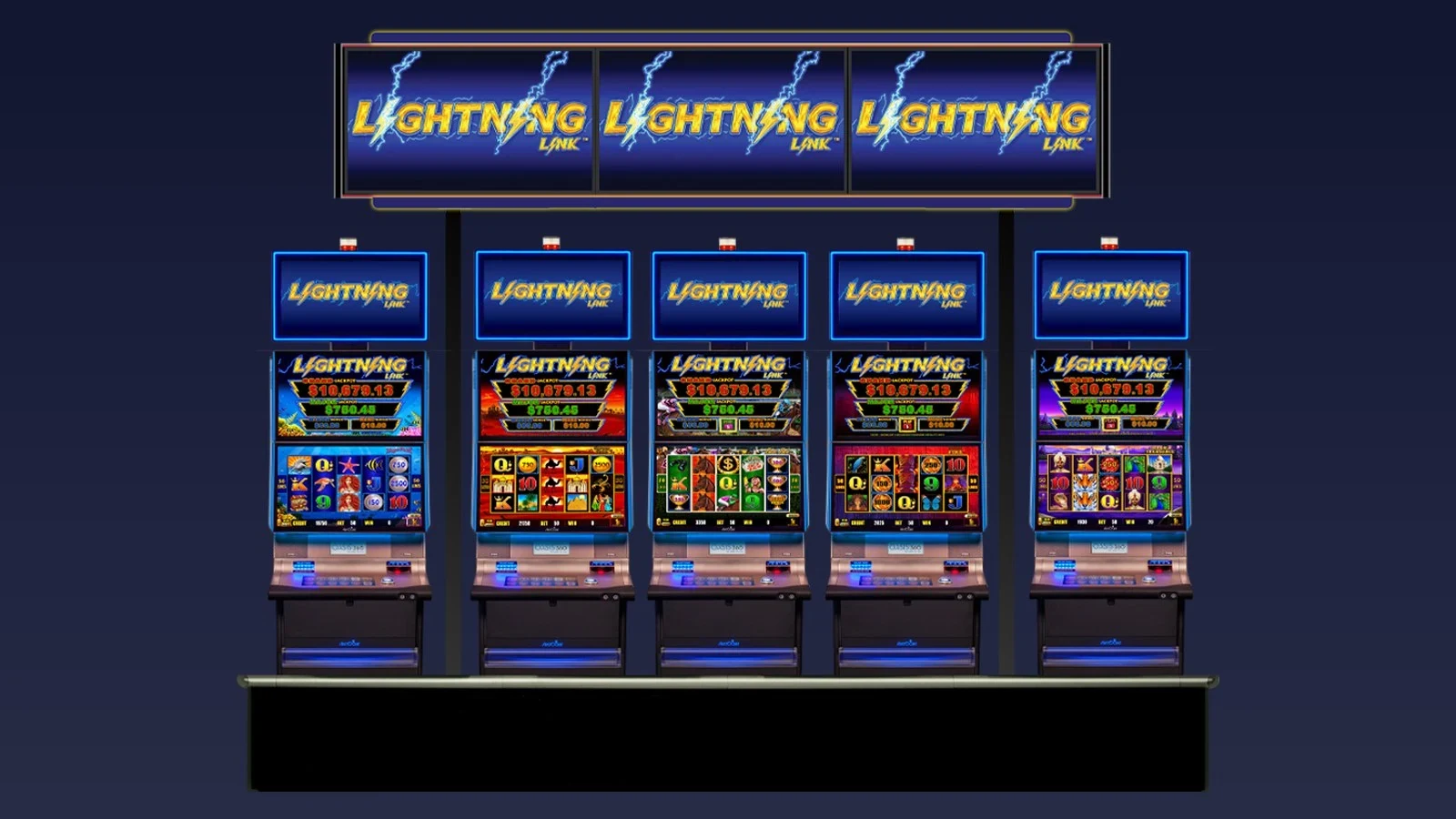
Among successful offline link jackpots, Aristocrat’s Lightning Link is always on the list. According to Australian business news reports, Lightning Link was created in 2014 by Aristocrat’s design studio High Roller Gaming. In a March 2016 press release, Aristocrat described the game as its first multi-denomination progressive link where players can choose their denomination, and its first European installation was at a casino in Duisburg, Germany in late 2015.
The core of Lightning Link is Hold & Spin. When a certain number of coin symbols land, they lock in place while respins run, and the more of the screen you fill, the closer you get to the Grand, Major, Minor and Mini jackpots. In a 2025 interview, Aristocrat’s product lead said Hold & Spin was a mechanic built for Lightning Link. The jackpot setup is mixed as well: the big jackpots run on a link that multiple machines grow together, and the small ones on per-machine standalone progressives (SAP).
In December 2017, Aristocrat announced that its follow-up link, Dragon Link, was spreading across North American casinos. Several Asian-themed games share the same “Orb” symbol and the same denominations, with the Grand jackpot run as a linked progressive and the rest as per-machine progressives. Dragon Link was named one of Casino Journal’s 20 innovative technologies in 2016.
The link in Macau - Dabok Dajae
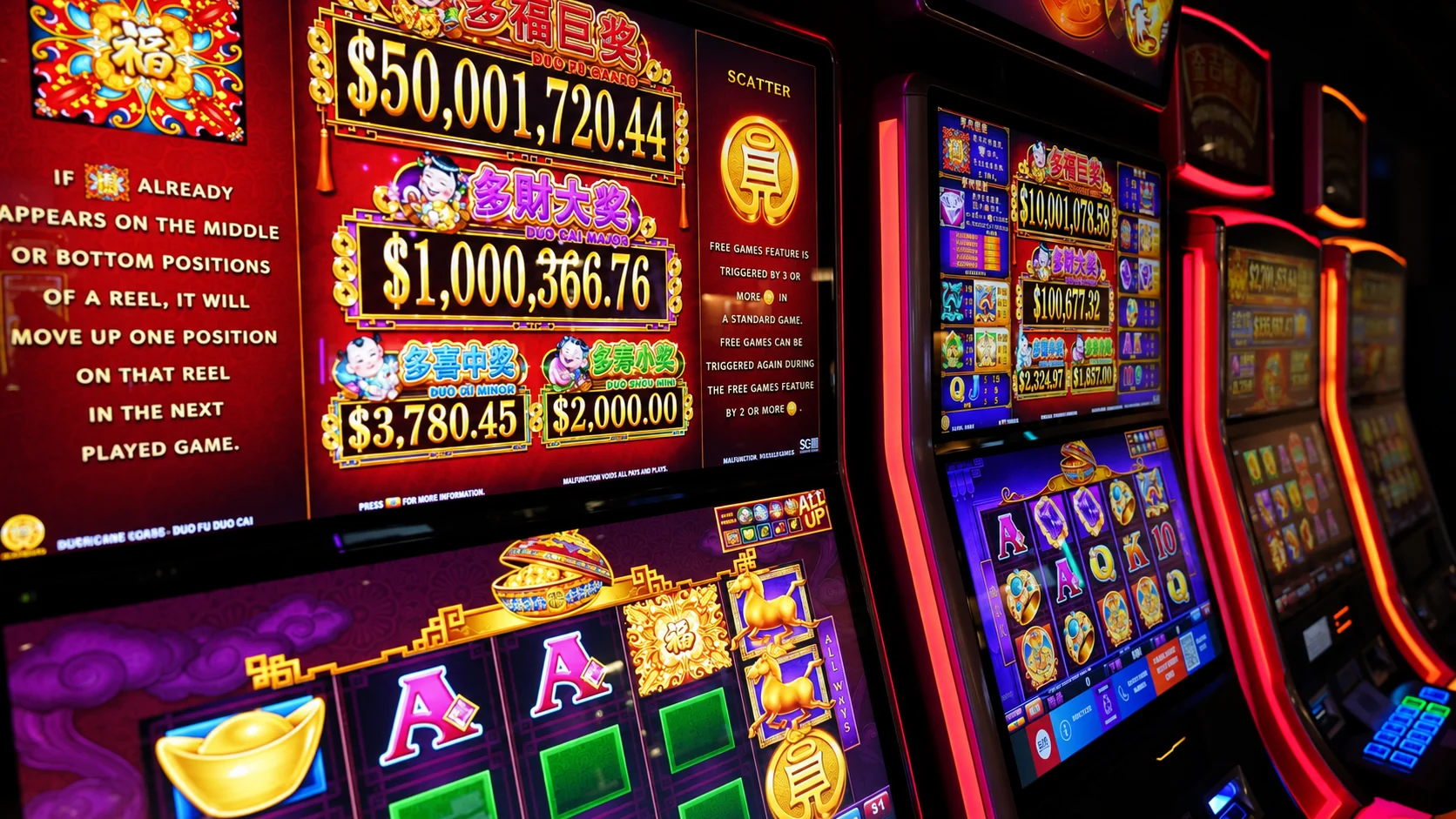
The most famous link jackpot in Asian casinos is Duo Fu Duo Cai. It debuted in mid-2012 in Macau with 88 Fortunes and 5 Treasures, and today it is made by Light & Wonder. Duo Fu Duo Cai machines within the same casino grow four jackpot tiers together (Mini, Minor, Major and Grand), and different games keep being layered on top. Its origins and how the Fu Babies jackpot game plays out are covered in detail in Duo Fu Duo Cai, Part 1 in the AI Slot magazine.
Jackpots that must hit - must-hit-by and mystery jackpots
A traditional progressive drops only when a specific symbol combination appears. In theory, the amount can grow without limit. By contrast, the “must-hit-by” type guarantees a winner before the jackpot reaches a set amount. It is a form of mystery jackpot where the amount itself, not a symbol combination, is the trigger.
Here is how it works. Each time the jackpot resets, a “hidden winning amount” is set at random somewhere between the seed and the cap, and the bet that pushes the jackpot past that amount wins. GLI-12 requires that this hidden amount be set at random at every reset and that no one be able to learn it by any means.
For example, take a jackpot with a seed of 100 and a cap of 500 (hypothetical numbers for illustration). The hidden winning amount is somewhere between 100 and 500. If the on-screen amount reaches 480, the remaining range has indeed narrowed, but you still cannot know exactly what the hidden amount is. And that last stretch is chased by many machines and many players at the same time.
Online, the time-based must-drop is widely used. Red Tiger launched its Daily Drop Jackpots network in April 2019 and added an hourly must-drop jackpot in October of the same year. Dream Drop, which Relax Gaming released in May 2022 with Temple Tumble 2 Dream Drop, was presented as a structure where all five tiers (Rapid, Midi, Maxi, Major and Mega) are guaranteed to be won. According to the announcement, the maximum prize rises by 500,000 euros for every two jackpots that drop, so the Mega jackpot cap can grow up to 10 million euros.
Progressive jackpot timeline, from 1986 to today
- January 1984: IGT engineers file a patent for a multi-progressive system linking multiple machines to a central controller (registered as US Patent 4,837,728 in June 1989)
- March 1986: IGT’s Megabucks launches in Nevada as the first wide-area progressive (seed of $1 million)
- Early 1987: First Megabucks jackpot of about $4.99 million, at Harrah’s in Reno
- March 2003: Megabucks pays $39.71 million at the Excalibur in Las Vegas, a Guinness record for the “largest slot machine win”
- September 2005: Megabucks seed raised to $10 million
- November 2006: Microgaming launches Mega Moolah
- January 2009: NetEnt launches Mega Fortune
- September 2011: Mega Fortune pays 11.7 million euros, recognized as the Guinness online record that December
- Mid-2012: Duo Fu Duo Cai debuts in Macau
- January 2013: Mega Fortune pays 17,861,813 euros, in Finland
- October 2015: Mega Moolah €17,879,645, Jon Heywood, UK (current Guinness-listed record)
- December 2015: Aristocrat Lightning Link, first installed in Europe
- December 2017: Dragon Link North American rollout announced
- September 2018: Mega Moolah €18,915,872.81
- April 2019: Red Tiger Daily Drop Jackpots network
- Early 2020: Games Global WowPot launches with a €2 million seed
- April 2021: Absolootly Mad Mega Moolah €19,430,723.60, Belgium
- May 2022: Relax Gaming Dream Drop
- June 2023: Pragmatic Play Jackpot Play
- December 2023: WowPot €38,461,200.95, the highest online payout
- April 2025: Big Time Gaming MegaPot debuts with Big Bucks Deluxe (a random prize that changes on every spin)
The beginning – IGT Megabucks and the wide-area progressive
It was IGT of Reno, Nevada, that turned the progressive jackpot into a brand. The Las Vegas Advisor records Megabucks, launched in Nevada in March 1986, as the world’s first wide-area linked progressive system. It tied together dollar slots across multiple casinos and started with 1 million dollars already in the pot.
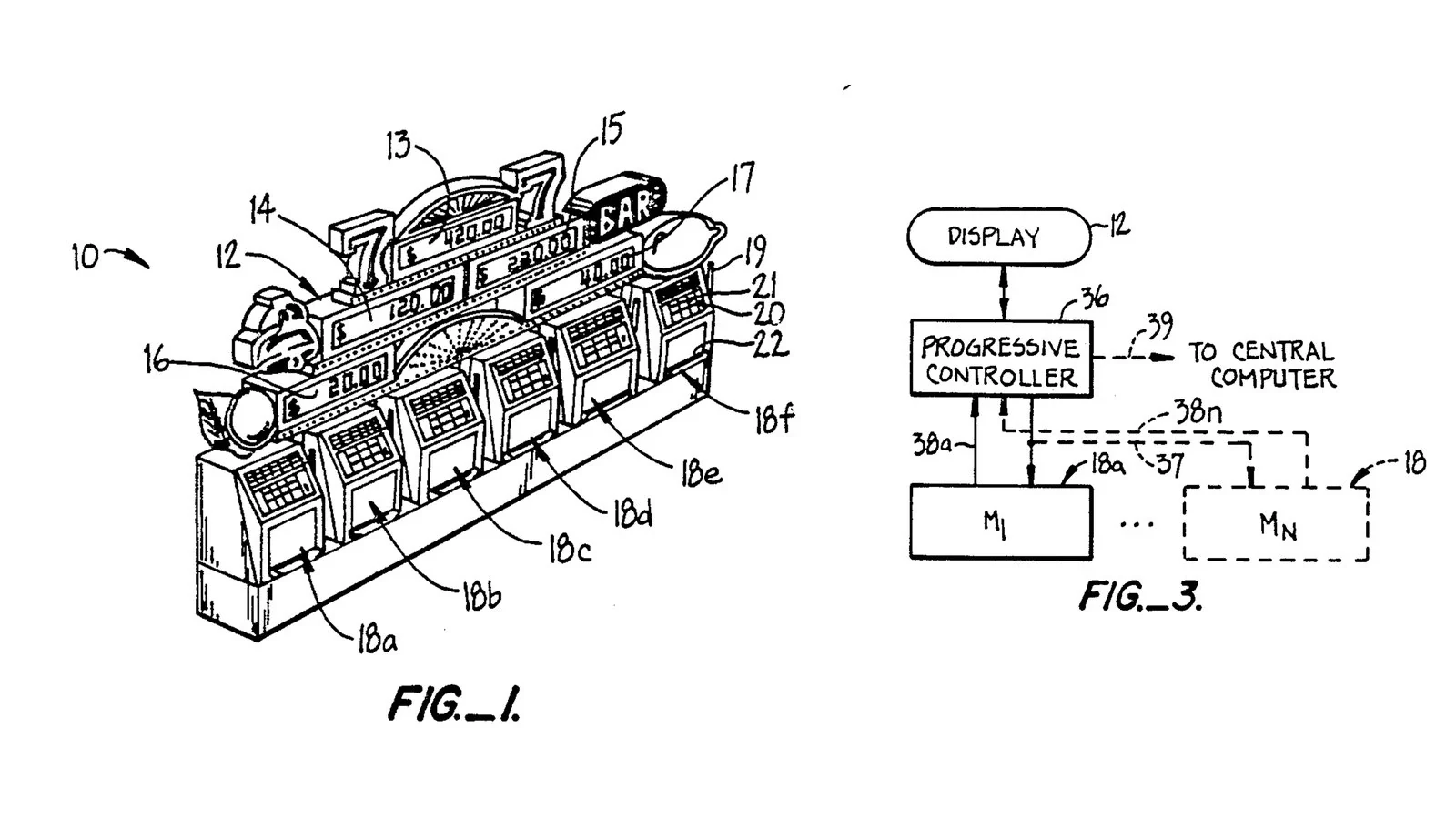
The technical foundation came earlier. In January 1984, IGT’s Robert Barrie and John Bengtson filed a patent for a “multiple progressive game system that fixes the payout at the start of a game.” A progressive controller collects the coin-in and win data from multiple machines, raises the jackpot meter, sends that value back to the machines, and connects to a central computer if needed. When one machine wins, the others reset to the starting amount, and games already in progress are settled at the jackpot amount from the moment the coin was inserted.
A former IGT staffer who ran the Megabucks project recalled in an industry column that he first proposed the wide-area progressive concept to Reno’s Cal Neva casino in the fall of 1985. Until then, he said, no one had built a link that spanned multiple casinos.
The results went into the record books. The first Megabucks jackpot, about $4.99 million, hit at Harrah’s Reno in early 1987 (sources differ on whether the date was January 1 or February 1). On March 21, 2003, a 25-year-old software engineer won $39,713,982.25 at the Excalibur in Las Vegas. Guinness lists this win, from Megabucks then linked across 157 Nevada casinos, as the “largest slot machine win.” Elmer Sherwin is known as a two-time winner: $4.6 million on the Mirage’s opening day in 1989, and $21.1 million at the Cannery in September 2005.
Megabucks is just as hard to hit. You need to bet $3 to qualify for the top jackpot, and the probability of three Megabucks logos, as calculated by casino math expert Michael Shackleford, is 1 in 49,836,032. As of a 1999 report, 657 machines were installed in Nevada alone, with separate systems in Atlantic City and Mississippi.
Going online – NetEnt Mega Fortune and Microgaming Mega Moolah
As online casinos grew, wide-area progressives moved to “network jackpots shared by multiple operators.” Two names opened this era: NetEnt and Microgaming.
Mega Fortune - NetEnt’s global jackpot
According to official NetEnt information, Mega Fortune was released on January 23, 2009. It is a 5-reel, 3-row, 25-payline game featuring speedboats and champagne, and landing 3 bonus symbols opens the three-ring wheel bonus game. When the wheel stops on the arrow, you move on to the inner wheel, and the closer to the center, the closer to a bigger jackpot. The bonus ends when either a coin prize or a jackpot is awarded. NetEnt describes the expected payout of this global jackpot as €4 million.
Mega Fortune broke the online jackpot record twice. In September 2011, a young Norwegian player won €11.7 million at Betsson, and Guinness recognized it that December as the largest online slot jackpot. On January 20, 2013, a Finnish player won €17,861,813 at Paf, setting the record again.
Mega Moolah - the millionaire maker
Microgaming’s Mega Moolah was released in November 2006. A December 2019 report mentions “last month’s 13th anniversary.” It is a 5-reel, 25-payline game in which a jackpot wheel can open at random on any spin, with one of four jackpot tiers at stake: Mini, Minor, Major and Mega. It is now operated by Games Global, which took over Microgaming’s game supply business.
Mega Moolah’s records are deeply entwined with Guinness.
- October 6, 2015: British soldier Jon Heywood won £13,213,838.68 on Betway with a 25p bet. Guinness converted this to €17,879,645 and recognized it as the “largest online slot jackpot payout.” It narrowly topped the previous record, set on Mega Fortune in 2013.
- September 28, 2018: A player at Grand Mondial Casino won €18,915,872.81 with a €0.75 bet.
- April 27, 2021: A €19,430,723.60 jackpot hit on the spin-off game Absolootly Mad Mega Moolah at Napoleon Sports & Casino in Belgium.
One caution. As of October 2026, the holder of the “largest online slot jackpot (nominal)” on Guinness’s official page is still John Heywood from 2015. The 2018 and 2021 wins were larger in amount but are not reflected on the Guinness page. “Guinness record” and “highest amount ever” are two different things.
2023: the €38.46 million WowPot
The highest online slot payout revealed so far came from Games Global’s WowPot!. On December 20, 2023, Alchemy Gaming’s Wheel of Wishes paid out €38,461,200.95 (a win in other currencies converted to euros). WowPot is a 4-tier progressive that launched in early 2020 on Wheel of Wishes with a €2 million seed, and the previous record was €17.5 million on Book of Atem WowPot in 2021. On December 24 of the same year, Book of Mega Moolah also paid out about €13.5 million.
Jackpot design differs by provider
Even among progressives, each provider aims in a different direction.
- NetEnt: Its roots are classic games like Mega Fortune and Hall of Gods, where a three-tier jackpot is chosen inside a bonus game. More recently it offers local jackpots that disclose contribution rates and seed rules, like Divine Fortune Gold, alongside fixed jackpots, like Divine Fortune Black.
- Games Global (formerly Microgaming): Like Mega Moolah and WowPot, multiple games share one huge network jackpot. As of 2021, cumulative payouts from the Microgaming jackpot network exceeded €1.3 billion.
- Red Tiger: Focused on “frequently hitting jackpots,” such as Daily Drops that must hit every hour and every day.
- Relax Gaming: With Dream Drop, it combined a five-tier must-win structure with a Mega jackpot whose cap keeps rising.
- Pragmatic Play: Jackpot Play, released in June 2023, is a local progressive network that operators set up within their own brands. Four tiers (Minor, Major, Mega and Grand) drop at random during the game, and a 4×3 gem pick decides the prize.
- Big Time Gaming: MegaPot aims for Mini, Midi and Mega prizes inside Hold & Spin, and according to public information it is a random prize that changes on every spin.
- Aristocrat and Light & Wonder: offline, they mix link jackpots with per-machine progressives, turning the sight of a whole row of machines growing a jackpot together into the product itself.
Jackpot games you can try on AI Slot
AI Slot has several games that let you follow the history of progressive jackpots firsthand. Unfortunately, Mega Moolah and WowPot games are not listed yet.
- NetEnt classic jackpots: Arabian Nights, released in November 2006, awards the progressive jackpot when five Jewel Merchant wilds land on a bet line. Mega Joker is a classic slot where a progressive jackpot can be won in random game rounds.
- NetEnt three-tier jackpots: Worth comparing are Mega Fortune’s three-ring wheel and the shield-breaking bonus in Hall of Gods (Mini, Midi, Mega), released in November 2010.
- The Divine Fortune family: From the original to Divine Fortune Megaways, Divine Fortune Black and Divine Fortune Gold, you can see how progressive and fixed jackpots are split within one series.
- Dream Drop: Relax Gaming’s Dream Drop games, including Temple Tumble 2 Dream Drop, are listed.
- Jackpot Play and Megapots: you can also try Pragmatic Play’s Fire Hot and Shining Hot Jackpot Play series, and Big Time Gaming’s Big Bucks Deluxe and Millionaire Megapots.
What to watch for when reading jackpot game numbers
Max multipliers leave out the jackpot
Mega Fortune’s official max multiplier is 1,700x. At the minimum bet of €0.25, that comes to only €425, which doesn’t match jackpots in the millions of euros. For progressive games, the max win multiplier should be read as covering the base game and bonus, excluding the jackpot. Conversely, in games with fixed jackpots like Grand Spinn, the jackpots are also shown as multipliers.
The jackpot’s share is included in the RTP
A progressive game’s RTP is a long-term average that includes the jackpot contributions. Because jackpots are paid out to a tiny number of players, the return most players actually experience can feel lower than the displayed RTP. That is why you should not simply compare the RTP number with a fixed-jackpot game.
It doesn’t tell you when the built-up amount will “hit”
In a regular progressive, the chance of winning on each spin is the same no matter how large the amount is. Since a long drought does not mean it is about to hit, beware of the gambler’s fallacy. In a must-hit-by jackpot too, the hidden winning amount is set at random at each reset and is never disclosed.
The jackpot amount in a demo is not a real pool
Free demos involve no real money, so there are no contributions from other players. Treat the jackpot figure on a demo screen as presentation, and use the demo instead to see how a jackpot game starts, how many tiers it has, and under what conditions the tiers are decided.
FAQFrequently Asked Questions
What is the difference between a progressive jackpot and a regular jackpot?
A regular (fixed) jackpot has its amount set in advance, such as a multiple of the bet. A progressive jackpot grows every time the game is played, as part of each bet is added, and returns to the seed amount once it is won.
What was the first progressive jackpot slot?
IGT Megabucks, launched in Nevada in March 1986, is recorded as the first wide-area progressive that spanned multiple casinos. IGT’s multiple-progressive patent, which links several machines to a central controller, was filed in January 1984.
What is the biggest online slot jackpot ever?
The highest publicly reported payout is €38,461,200.95, won on the Wish Wheel of the Games Global WowPot network on December 20, 2023. The largest online slot jackpot listed on Guinness’s official page is Mega Moolah’s €17,879,645 from October 2015 (Jon Heywood).
What is the biggest offline slot win ever?
By Guinness’s standard, the largest slot machine win is $39,713,982.25, hit on IGT’s Megabucks at the Excalibur in Las Vegas on March 21, 2003.
Is it better to play a must-hit-by jackpot when the amount is close to its cap?
Because the hidden winning amount is set at random somewhere below the cap, the closer the jackpot gets to the cap, the narrower the remaining range becomes. However, that amount is never disclosed, and many machines and players chase the same jackpot at once, so you cannot say whether it favors you or not. The base game’s RTP and house edge still apply as usual.
What is the difference between local jackpots and network jackpots?
A local jackpot is grown only by the machines and players within one casino or one operator. A network (wide-area) jackpot shares a single pool across multiple casinos or operators, so it builds much faster and bigger, but there are just as many players chasing it.
Related reads
For a look at linked jackpots in the real world, see the Dabok Dajae series in the magazine, and for how jackpot entry features like Hold & Spin work, see the wiki. How other slot features such as tumble came about and spread is covered in the “Complete Tumble Analysis” guide. If you want to see the prototype of the progressive jackpot for yourself, check the NetEnt free slots list and try the Mega Fortune and Hall of Gods demos to see how a three-tier jackpot bonus plays out.
Sources: IGT US Patent 4,837,728 (USPTO), Guinness World Records, Las Vegas Advisor, Las Vegas Sun, Casino Enterprise Management, CDC Gaming, NetEnt official game information, GLI-12 progressive standard (GLI), PR Newswire, InterGame, SBC News, European Gaming, iGaming Business, Gambling Insider, Aristocrat press release, Business News Australia